Duplicate content in AI-generated pages is one of the most misunderstood problems in local SEO. The fear is understandable: you want 30 location pages, you know AI tends to follow patterns, and you’ve heard that Google penalises duplicate content. Most of that fear is based on a myth.
The real risks are narrower and more specific: doorway pages, keyword cannibalisation, and Google quietly choosing one page over another to index. Understanding the difference changes how you approach building at scale.
This article walks through what actually puts location pages at risk, and what you can do about it at each stage of the process.
The myth: duplicate content will get you penalised
Google is clear on this. Some duplicate content on a site is normal and is not a violation of its spam policies. When Google finds pages that are the same or very similar, it clusters them and picks one canonical version to represent the group. The others are crawled less often and contribute less to your visibility, but they are not penalised in any punitive sense.
The penalty myth likely comes from conflating two separate things: the technical consequence of duplication (your pages compete with each other and the weaker ones get filtered) and a spam violation (Google actively downgrades your site). The first is a real problem. The second only applies when duplication is part of a deliberate attempt to manipulate search, not when it happens because your service pages share a similar structure.
That said, “not a spam violation” is not the same as “fine to ignore.” Filtered pages do not rank. If Google is only surfacing one of your ten location pages, the other nine are doing nothing for you.
The real risks: doorways, cannibalisation and Google’s canonical choice
The actual threats to a scaled local content strategy fall into three categories.
Doorway abuse. Google’s spam policies describe doorway pages as pages targeted at specific regions or cities that funnel users to one destination, or substantially similar pages that feel more like search results than a real site hierarchy. If your Bristol, Bath and Exeter pages are near-identical except for the city name, they fit that description. This is where a genuine spam risk exists, and it is worth reading more about how to build local landing pages without doorway-page risk.
Keyword cannibalisation. If two pages target the same or very similar keyword, Google has to choose between them. It may split ranking signals across both, meaning neither performs as well as one consolidated page would. This is a strategy problem as much as a content problem.
Google’s canonical choice. Even without cannibalisation, Google may decide your pages are similar enough to cluster. It picks the one it judges most complete and useful as the canonical. The others get crawled less and evaluated less. A rel="canonical" tag is a hint you can give Google, but it is not a rule Google is required to follow. The quality and distinctiveness of the page still matter.
These three risks are related but separate. Solving one does not automatically solve the others. For a broader look at where Google draws the line on scaled content, this breakdown of scaled content abuse is worth reading before you build at volume.
Before generation: blocking overlaps before they happen
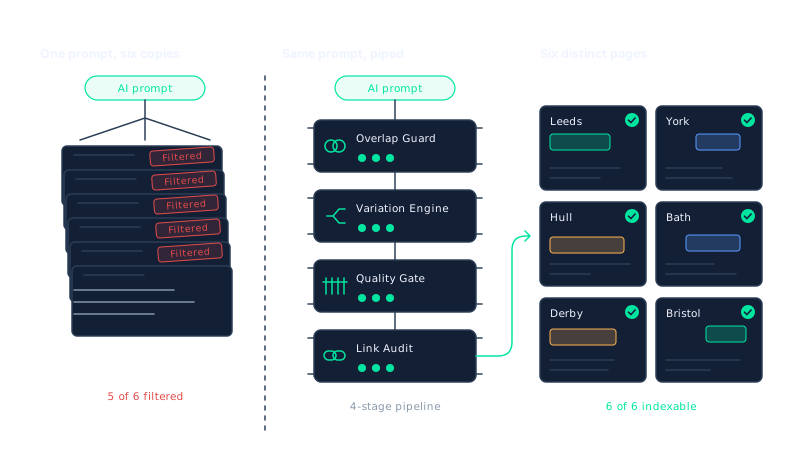
The most reliable way to avoid duplicate content in AI-generated pages is to catch the problem before any content is written. Writrex does this through an overlap guard that runs when you enter a new keyword and target area.
If an exact match already exists among your generated pages, the new page is blocked. If the match is close but not identical, you get a warning with a direct link to the competing page so you can decide what to do. That might mean consolidating, adjusting the keyword, or accepting the overlap and setting a canonical on one of the pages.
The guard is also aware of geographic qualifiers. Terms like “north,” “greater” and “surrounding” are treated as meaningful, not ignored. So “plumber in Greater Manchester” and “plumber in Manchester” will trigger a warning rather than sail through as distinct targets.
One honest limitation: the matching is token-based. It does not yet recognise synonyms. If you have an existing page for “air conditioning installation in Leeds” and you create a new one for “AC installation in Leeds,” the overlap guard will not connect them. That is a gap worth knowing about, and it means you still need to think about your keyword list before you generate at scale.
Competing pages that slip through are also surfaced later in Link Audit, so there is a second opportunity to catch and address them.
During generation: variation that goes beyond swapping town names
Replacing “Bristol” with “Bath” and calling it a new page is exactly what Google’s doorway guidance is aimed at. Real variation has to run deeper than that.
Writrex approaches this in several ways during generation. Headings are checked for cross-page repetition, so the same H2 structure does not appear verbatim across every location page. Section labels can be varied. Campaign angles can shift between pages, for example leading with speed of response on one page and with local knowledge on another. Tradesperson-style voice rules reduce the generic, template-heavy phrasing that makes AI content recognisable as AI content.
The AI detection shield, available on Starter plans and above, goes a step further by stripping stock AI phrasing and capping exact place-name repetition. It does not promise to defeat any specific detector tool, and it would be misleading to claim otherwise. What it does is reduce the surface-level signals that make pages feel interchangeable.
Crucially, the content that makes pages genuinely distinct, real testimonials, local case studies, specific pricing, has to come from you. The brand profiles system is where you supply that material, and the AI draws on it during generation rather than inventing it. A page about your boiler installation service in Coventry that references a real job you did there is structurally different from a page that mentions Coventry and nothing else.
Before publishing: the 38-check quality gate
Even with overlap detection and generation-time variation working correctly, a page can still come out weak. That is what the quality gate is for. Every page Writrex generates passes through 38 checks before it can be published. Thirty-one of those are weighted and produce a score out of 100. The remaining seven are blocking checks that a page must pass regardless of its score. The minimum to publish is 80.
Several of those checks address the duplicate content problem directly. The Trust and originality group includes a unique title check, a cross-site original headings check, and a doorway-similarity guard that flags pages which are too close to each other structurally. If a page triggers that last check, it does not publish. It is saved as a draft, and the reason is recorded so you can see exactly what failed.
The blocking checks include one that catches leftover default template copy. That matters more than it sounds. Template boilerplate is one of the clearest signals that a page was generated without care, and it is the kind of content that clusters with other near-identical pages in Google’s index.
Scores and the enforced gate apply to every edition, including Writrex Lite, so there is no version where pages can slip through without being evaluated.
One thing the quality gate does not do: it does not check your content against the wider web for plagiarism. The checks are internal, comparing pages within your own site. That is an important distinction, and it is worth being clear about it.
After publishing: orphan detection and canonical hints
Publishing is not the end of the process. Duplicate content in AI-generated pages often becomes a problem gradually, as a site grows and pages start competing with each other or sitting unlinked.
Link Audit addresses both issues. It reports any generated pages that have no inbound internal links, which are orphan pages. Google can still find orphans through sitemaps, but without internal links they carry very little weight and are crawled less often. Catching them early gives you the chance to wire them into the site properly. For a practical walkthrough of how to deal with these, the guide to finding and fixing orphan pages on a WordPress site is worth reading alongside this.
Link Audit also surfaces competing pages, the ones that slipped past or were created before the overlap guard was in place. From there, you can set a canonical URL on one of the competing pages to give Google a clear hint about which version to treat as primary. That hint is not a hard instruction. As Google’s own documentation states, a rel="canonical" tag is a signal, not a rule, and Google may choose differently if it judges another page more complete. But it is still the right thing to do, and it is better than leaving the choice entirely to the crawler.
Two practical notes on Link Audit: it is read-only, so it reports rather than fixes. And links added inside some page builders may not be visible to it, which means the orphan count could be understated if your internal linking happens inside a builder’s block editor rather than in post content.
What Writrex cannot do for you
It is worth being direct about the limits, because understanding them helps you use the tool well rather than expecting it to do something it does not.
The overlap guard works on token matching. That means it will catch “boiler repair Leeds” competing with “boiler repair Leeds North,” but it will not catch “AC installation Bristol” competing with “air conditioning installation Bristol.” Those two phrases mean the same thing, and the guard does not yet recognise them as synonyms. If your keyword list mixes abbreviations and full terms, you need to standardise it yourself before generating. That is not a workaround. It is just good practice when building at scale.
The quality gate checks are internal. They compare pages within your own site. They do not scan the wider web, so they will not flag content that resembles pages on competitor sites or generic AI output that happens to be common across the internet. Originality in that broader sense is your responsibility.
Canonicals are hints, not instructions. Setting a canonical on a competing page is the right move, but Google may still choose differently if it judges another page more complete or better linked. No plugin can override that. What you can do is make the preferred page genuinely stronger, which brings us to the more important point.
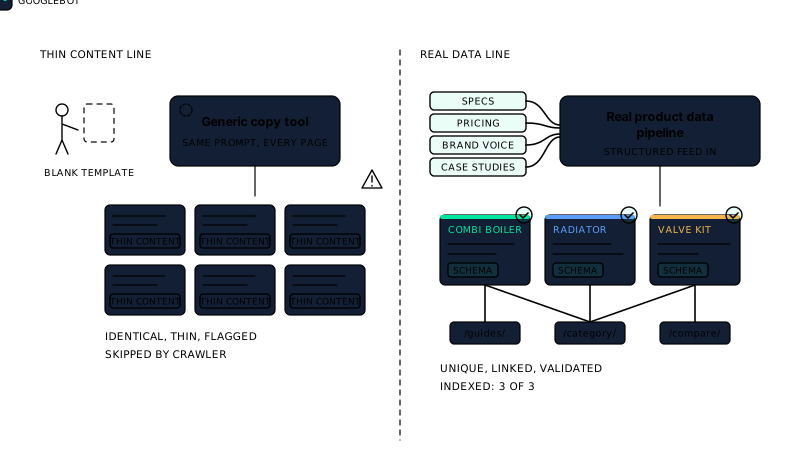
Finally, Writrex does not generate content from information it finds on the web. If you give it nothing specific to work with, it will produce something structurally sound but thin. The variation features reduce the template look, but they cannot invent real detail that does not exist.
The one thing that makes pages genuinely different
Duplicate content in AI-generated pages is ultimately a data problem, not a generation problem. Two pages look the same because the same inputs produced them. The fix is different inputs.
That means feeding the generator real information: your actual pricing, the specific services you offer in each area, genuine customer testimonials, case studies from real jobs, and anything else that is true of your business and not a competitor’s. In Writrex, this is what brand profiles are for. A brand profile holds your tone of voice, your case studies, your statistics and your differentiators. When that information is present, the generated page reflects it. When it is not, the page reflects nothing in particular.
This is also what Google is actually asking for when it warns against scaled content abuse. The question is not whether AI was involved. The question is whether the page adds something a user could not find anywhere else. A page about boiler servicing in Coventry that includes your actual call-out time, your real pricing range and a testimonial from a customer in that area is a different page from a generic one, regardless of how it was produced. One that was written by hand but contains nothing specific is just as thin as a generated one.
If you want to understand more about what Google considers the line between useful scaled content and abuse, the post on what Google actually says about AI-generated content covers the source material clearly.
The tools handle structure, consistency and internal coherence. The local detail that makes a page worth reading has to come from you.
Frequently asked questions
Is duplicate content in AI-generated pages a Google penalty?
Not by itself. Google’s own documentation says some duplicate content is normal and not a spam violation. The real risks are doorway abuse, keyword cannibalisation and Google choosing a different page than you intended as the canonical. Understanding that distinction helps you focus on the problems that actually affect rankings.
Will Google filter out my location pages if they look similar?
It might. When Google finds pages it judges to be the same or very similar, it clusters them and picks one to show. The others get crawled less often and may not appear in results at all. Making each page genuinely different, with real local detail, is the most reliable way to avoid that outcome.
What is the difference between a doorway page and a legitimate location page?
Google’s spam policy targets pages that funnel users to a single destination and offer nothing beyond a search result. A legitimate location page gives a user in that area something useful: real pricing, specific services, local contact details, or genuine testimonials. The content has to serve the visitor, not just the keyword.
Does setting a canonical tag guarantee Google will use it?
No. Google treats a rel=”canonical” tag as a hint, not an instruction. If it judges a different page to be more complete or better linked, it may choose that one instead. The best approach is to make the page you want indexed the strongest version, not to rely on the tag alone.
Can I use AI to build location pages at scale without risking scaled content abuse?
Yes, if each page adds genuine value. Google’s concern is pages that add nothing a user could not find elsewhere. AI handles structure and consistency well. The detail that makes a page different, your real pricing, local case studies, specific services, has to come from you. That combination is what keeps scaled production on the right side of the line. The post on how to build local landing pages without doorway-page risk covers the practical steps in full.
Duplicate content at scale is a solvable problem when you treat it as a data question rather than a generation one. Get the inputs right, check what is being produced, and keep your internal structure clean. The tools take care of the rest. For a broader look at how AI fits into a sound SEO approach, GEO vs AEO vs SEO: a plain guide for WordPress site owners is worth reading alongside this one.
Writrex writes from your real business facts and checks every page before it publishes. Start with Writrex Lite for free.