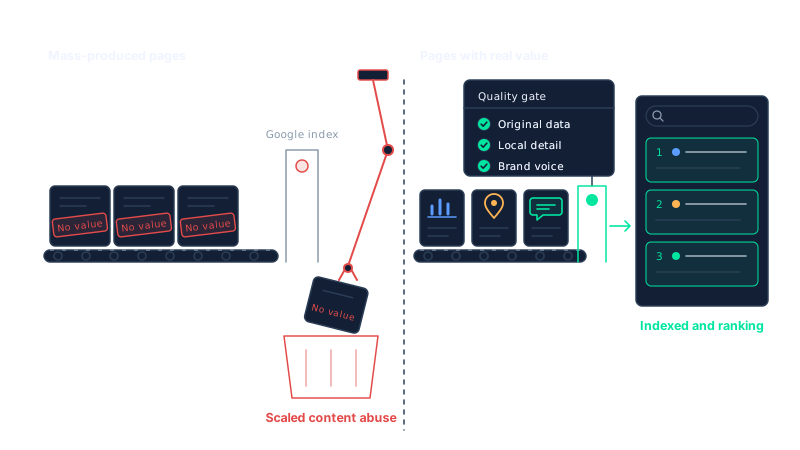
Scaled content abuse is the term Google uses for publishing large numbers of pages whose main purpose is to manipulate search rankings rather than help users. Publishing many AI-assisted pages is not, by itself, an offence. Google’s spam policies are explicit on this point: the policy targets intent and value, not the tool used to produce the content.
That distinction matters. Agencies and freelancers running content programmes for dozens of clients, and WordPress site owners building out local or product coverage, can publish at scale without penalty, provided every page genuinely serves a reader. The risk comes when volume becomes the goal and usefulness becomes an afterthought.
Google’s spam policies page was last updated on 28 August 2026, and the most recent spam update ran from 18 to 21 August 2026, so the guidance below reflects the current position.
What scaled content abuse actually means
Google defines scaled content abuse as generating many pages primarily to manipulate rankings rather than to help users. The definition covers content that is unoriginal, provides little or no value, and is produced at volume. Critically, the policy applies regardless of how the content is created. Human writers, AI tools, scraping scripts and template systems all fall under the same standard.
The word “mainly” is doing real work in that definition. A site that publishes a hundred location pages because it genuinely serves customers in a hundred locations is in a different position from a site that publishes a hundred location pages because it wants a hundred ranking URLs. The content on those pages, and the intent behind them, is what separates the two.
This is why volume alone is not a useful signal for whether you are at risk. A single thin page can violate the policy. A thousand well-researched, genuinely useful pages can be perfectly clean.
The examples Google lists in its spam policies
Google’s spam policies documentation gives five concrete examples of scaled content abuse. Understanding each one helps you audit your own publishing process honestly.
- Using generative AI to create many pages without adding value. AI is named here as one method, not the offence itself. The offence is the absence of added value.
- Scraping feeds or search results and rewriting them through synonymising or translating. Spinning existing content, whether by hand or by algorithm, falls squarely inside the policy.
- Stitching content from different pages without adding value. Aggregating paragraphs from other sources and presenting the result as original content is treated as abuse.
- Spreading content across multiple sites to hide its scale. Publishing the same thin content across a network of domains to obscure how much of it exists is specifically called out.
- Pages stuffed with keywords that make little sense to a reader. Keyword density tactics that produce incoherent text are treated as scaled abuse when applied at volume.
Notice that four of the five examples have nothing to do with AI. The common thread is producing content that serves rankings rather than readers. For a fuller look at what Google’s documentation actually says about AI specifically, see what Google actually says about AI-generated content.
The practical implication is straightforward. If every page you publish answers a real question, reflects genuine information about your business or products, and reads as something a person would find useful, you are not producing scaled content abuse. If pages exist only to occupy a keyword slot, the method used to write them is irrelevant.
Why the policy targets intent, not the tool
Google’s spam policies are explicit on this point: scaled content abuse is defined by purpose and value, not by the method of production. AI is listed as one example of how abuse can happen, not as a category of content that is inherently suspect. A page written by a human copywriter who simply rewords a competitor’s article is just as much a violation as a thousand AI-generated pages that say nothing original.
This distinction matters practically. It means you cannot make your publishing process safe by switching tools, and you cannot make it unsafe simply by using AI. What determines your risk is the question you ask before any page is written: does this page exist to help a specific person, or does it exist to occupy a position in search results?
If you can answer the first question honestly, the tool becomes secondary. A brand profile that holds your real pricing, actual case studies and a defined tone of voice gives AI something genuine to work with. Pages built on that foundation are adding value because they are drawing on information that exists nowhere else on the web. Pages built by feeding a model a keyword and a word count are not, regardless of how polished the output looks.
Google’s systems, both automated and through human review, are looking for patterns that suggest a site is manufacturing content rather than creating it. Volume is one signal among many, and it is not a reliable one on its own. Thin content at low volume is just as detectable as thin content at high volume.
How doorway abuse differs, and why it matters for local sites
Doorway abuse is a separate policy from scaled content abuse, and conflating the two leads to confused decisions about local SEO. It is worth being precise about what each one covers.
Google defines doorway abuse as pages that target specific regions or cities primarily to funnel users toward one destination, and pages that are substantially similar to each other in a way that looks more like a set of search results than a coherent site. The emphasis is on pages that exist as a layer between the user and the actual content, rather than as the destination themselves.
For a local services site or a WooCommerce store with regional delivery pages, this creates a clear line. A page for “emergency plumber in Bristol” that contains real information about your Bristol coverage area, your actual response times and a direct way to contact or book is a legitimate landing page. A page for “emergency plumber in Bristol” that contains one paragraph of generic text and a button pointing to your main contact page is a doorway. The distinction is whether the page itself is useful or whether it is just a routing mechanism.
The risk for local sites is not that they have many location pages. It is that those pages are substantially similar to each other, with only the city name changed. That pattern triggers both doorway concerns and scaled content abuse concerns simultaneously. For a detailed look at how to structure these pages safely, building local landing pages without doorway-page risk covers the practical approach.
Internal linking structure also plays a role here. A set of location pages that link coherently to service pages, category pages and each other signals a genuine site hierarchy. A set of pages that all point to one conversion page and have no other connections looks like a doorway network. Getting that structure right from the start, rather than fixing it after the fact, is considerably easier. Finding and fixing orphan pages on a WordPress site explains what to look for and how to address it.
What happens when Google finds a violation
Google’s spam policies are enforced through a combination of automated systems and human review. That combination matters because it means a site can be flagged algorithmically and then assessed by a reviewer, or flagged by a reviewer directly. Either path can lead to the same outcomes.
The consequences sit on a spectrum. At the lighter end, affected pages simply rank lower than they otherwise would. At the heavier end, pages are removed from search results entirely. The most serious outcome is a manual action, which is a formal penalty applied by a human reviewer and recorded in Google Search Console. A manual action does not resolve itself when you publish better content. It requires you to address the underlying issue and submit a reconsideration request.
Scaled content abuse violations are recoverable, but recovery takes time. Algorithmic penalties tend to lift when the underlying signals change, usually across a core or spam update cycle. Manual actions require active remediation. Neither is quick, and neither is guaranteed.
One practical point worth noting: Google’s spam policies page was last updated on 28 August 2026, following a spam update that ran from 18 to 21 August 2026. The policies are a living document. Checking them periodically is not paranoia. It is basic due diligence for anyone publishing at scale.
The practical checklist: what safe scaled publishing looks like
Scaled content abuse is about intent and value, not volume. The checklist below reflects that. Every item maps back to the question Google is effectively asking: does this page exist to help a user, or does it exist to manufacture a ranking?
- Each page has a distinct purpose. A page for a specific service in a specific location should answer questions a user in that location would actually have. If swapping the city name is the only meaningful difference between two pages, that is a problem.
- The content is not just reworded from another source. Synonymising or paraphrasing existing content, whether from your own site or elsewhere, without adding anything new is one of Google’s named examples of scaled content abuse.
- Pages are genuinely useful as a destination. A user who lands on the page should be able to accomplish something, get an answer, make a decision, or take an action, without being immediately bounced to a different page to find the real content.
- Keyword use is readable. If a sentence only makes sense because it needed to contain a phrase, rewrite it. Keyword stuffing is explicitly listed as a spam signal.
- The site has a coherent internal linking structure. Pages link to related content, category pages and service pages in a way that reflects how the site is actually organised. A set of pages that all funnel to one destination with no lateral connections is a red flag. The internal linking and orphan detection tools in Writrex are designed to catch exactly this kind of structural problem before it becomes one.
- Brand-specific information is consistent and accurate. Pricing, service areas, case studies and tone of voice should reflect the actual business, not generic filler. Brand profiles give AI-assisted content generation a factual foundation to draw from, which reduces the risk of publishing content that is technically fluent but factually hollow.
- Pages that do not meet quality standards are not published. This is the most direct safeguard. A page that fails a quality check should not go live. Holding it as a draft for review is the correct default.
None of these points are new requirements invented for AI content. They are the same standards that applied to human-written content. What changes with scale is the speed at which problems can accumulate if there is no systematic check in place.
How a quality gate protects you before pages go live
The checklist in the previous section describes what good scaled publishing looks like. A quality gate is how you enforce that description systematically, before any page reaches Google’s index.
The core problem with publishing at scale is that errors compound at the same rate as output. A single page with thin content is a minor issue. Two hundred pages with the same structural weakness is a pattern, and patterns are exactly what automated spam detection is built to find. Catching problems at the draft stage is not just tidier. It is the difference between a clean site and a scaled content abuse signal.
A quality gate works by running each page against a defined set of checks before it is published. Those checks should cover the things Google’s spam policies actually care about: readability, keyword density, factual consistency, internal linking, and whether the page has a clear purpose beyond ranking. If a page fails, it stays as a draft. It does not go live, and it does not become part of a pattern that could attract a manual review.
Writrex runs 38 checks on every page before it is eligible for publication. Pages that do not pass are held as drafts automatically. There is no option to override and publish anyway, which removes the temptation to push borderline content live under time pressure. That default matters. Most quality problems in bulk publishing happen not because the operator does not know the standard, but because the process has no hard stop.
The checks also cover structured data, which is worth mentioning separately. Structured data that is inaccurate or misleading is itself a spam signal under Google’s policies. Validating structured data at the point of generation, rather than auditing it retrospectively across hundreds of pages, keeps that risk contained.
There is a broader point here. A quality gate is not a guarantee that every page is excellent. It is a guarantee that no page below a defined threshold goes live without a human decision. That distinction matters because Google’s enforcement targets patterns, not individual pages. A systematic check breaks the pattern before it forms.
For agencies and freelancers managing multiple client sites, this kind of automated safeguard also protects the client relationship. A page that fails a quality check and stays as a draft is a problem you can fix quietly. A page that fails Google’s quality assessment after indexing is a problem that takes considerably longer to recover from.
Frequently asked questions
Is publishing AI-generated content at scale automatically scaled content abuse?
No. Google’s spam policies are explicit that the tool is not the offence. Publishing many AI-assisted pages is fine if each page is original, useful and written for a real user. The abuse definition requires intent to manipulate rankings and content that adds little or no value. Volume alone triggers nothing.
Can a manual action affect my whole site, or just the pages that caused the problem?
Both are possible. Google can apply a manual action to specific pages or to an entire site, depending on how widespread the pattern is. A site where hundreds of pages share the same structural weaknesses is far more likely to receive a site-wide action than one where a handful of pages fall short.
Do local landing pages for different cities automatically count as doorway pages?
Not if they are genuinely different and useful. The doorway abuse policy targets pages that are substantially similar and funnel users to a single destination rather than serving them directly. A city page with real local information, specific services and a clear place in the site hierarchy is not a doorway page.
What should I do if I think I already have a scaled content problem on my site?
Audit your lowest-traffic pages first. Look for thin content, duplicate structures and pages with no clear purpose beyond a keyword. Consolidate or improve what you can, and remove or noindex what you cannot fix. Checking for orphan pages on your WordPress site is a practical first step, since orphans often signal the same underlying problem.
Does structured data affect spam assessments?
Yes. Google’s policies treat inaccurate or misleading structured data as a spam signal in its own right. If you are generating structured data at scale, it needs to be validated at the point of creation. Retrospective audits across hundreds of pages are slow and easy to miss. Catching errors before publication is the only reliable approach.
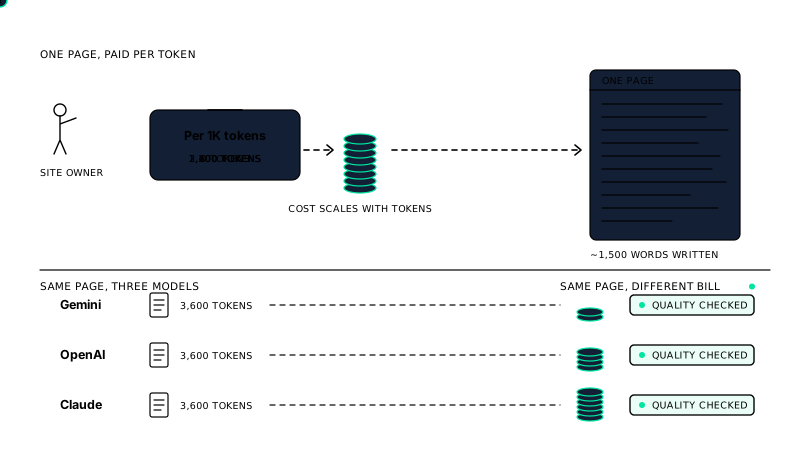
The line Google draws is consistent: intent and value, not volume and tooling. Build pages that genuinely serve users, check them before they go live, and scaled publishing stays well inside policy. For a deeper look at the cost side of publishing at scale, the breakdown of what AI content actually costs per page is worth reading before you plan a large project.
Writrex writes from your real business facts and checks every page before it publishes. Start with Writrex Lite for free.