GEO vs AEO vs SEO is the question more WordPress site owners are asking as search behaviour shifts. Google still sends the most traffic for most sites, but AI assistants, voice search and generative answer engines are changing what “showing up” actually means. Understanding all three disciplines helps you make smarter choices about where to spend your time.
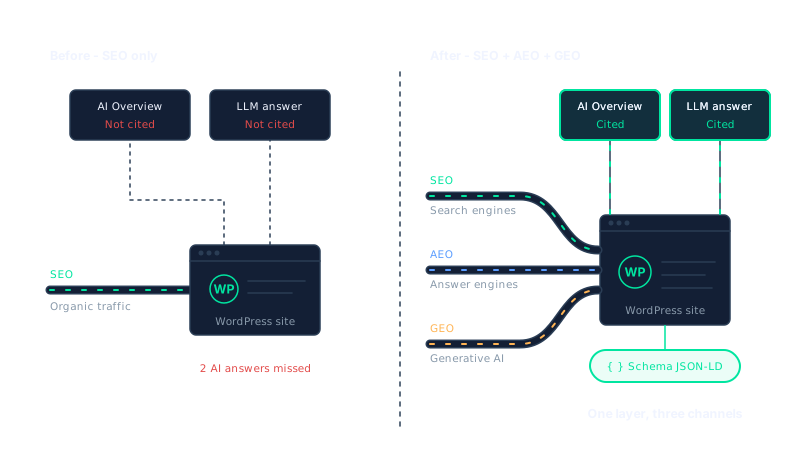
The short answer: SEO gets you ranked in traditional search results, AEO gets your content quoted in direct answers, and GEO gets your site cited by generative AI systems like ChatGPT, Gemini and Perplexity. They overlap more than they compete, and most WordPress sites need elements of all three.
This guide explains each discipline plainly, shows where they differ, and gives you practical steps to cover all three without starting from scratch.
What SEO still means in 2025
Search engine optimisation has not died. Google processes billions of queries every day, and organic search remains the largest single source of website traffic for most businesses. What has changed is the shape of the results page.
Featured snippets, People Also Ask boxes, AI Overviews and local packs now sit above the traditional blue links. Ranking on page one is no longer enough if your result sits below a block of AI-generated answers. SEO in 2025 means earning a position that still gets clicked, not just a position that exists.
The fundamentals have not changed: quality content that matches search intent, a technically sound site, and credible links pointing to it. What has changed is that thin, keyword-stuffed pages lose ground faster than they used to. Google’s quality guidance has always rewarded genuine expertise, but enforcement is sharper now.
For WordPress site owners, SEO still means getting your meta titles and descriptions right, fixing crawl errors, building internal links and publishing content that answers real questions thoroughly.
What AEO is and why it emerged
Answer engine optimisation is the practice of structuring content so that search engines and AI systems can extract a direct, quotable answer from it. The term reflects a shift in how people search: more questions, more voice queries, more expectations of an instant answer rather than a list of links to explore.
AEO emerged because Google started rewarding content that answered questions clearly and concisely. Featured snippets were an early signal. When a user asks “how long does it take to register a UK limited company?” and Google shows a single paragraph pulled from one page, that page has effectively won the answer for that query, regardless of whether the user clicks through.
The core AEO techniques are straightforward. Write a clear question as a heading, then answer it directly in the first two sentences below. Use structured formats: short paragraphs, numbered steps, definition-style responses. Avoid burying the answer in preamble. These habits also make content easier for AI systems to parse, which is where AEO starts to shade into GEO.
AEO does not require a separate content strategy. It is mostly a discipline of writing more clearly and structuring pages more logically, something that improves traditional SEO rankings at the same time.
What GEO is and how it differs from AEO
Generative engine optimisation, or GEO, is the practice of making your content more likely to be cited, quoted or summarised by AI-generated responses. Think ChatGPT, Google’s AI Overviews, Perplexity, Microsoft Copilot and similar systems. Where AEO targets a specific answer slot in a traditional search result, GEO targets the broader process by which a large language model decides what sources to draw on when composing a response.
The distinction matters. AEO is largely about structure: clear headings, direct answers, logical formatting. GEO goes further. It asks whether your site reads as a credible, authoritative source that an AI system would trust enough to reference. That means demonstrating genuine expertise, providing specific detail rather than generic advice, and giving AI systems enough context to understand who you are, what you do, and why your content is reliable.
A local plumber’s site that lists vague service descriptions will not be cited when someone asks an AI assistant which plumbers in Manchester handle emergency boiler repairs. A site with detailed service pages, real pricing ranges, named engineers and customer outcomes stands a much better chance. That specificity is the heart of GEO.
Structured data plays a central role here. Marking up your content with schema helps AI systems read entity relationships, not just keywords. Writrex’s structured data features are built around exactly this need, connecting content signals so that both search engines and generative systems can interpret your pages accurately.
How the three disciplines overlap
GEO vs AEO vs SEO can sound like three separate workloads. In practice, the overlap is substantial. A page that ranks well in traditional search tends to have clear structure, genuine depth and credible signals, which are the same qualities AEO and GEO reward. Fixing one usually improves all three.
The differences are mostly in emphasis. SEO prioritises crawlability, authority and keyword relevance. AEO prioritises answer clarity and formatting. GEO prioritises entity credibility and contextual specificity. A well-built WordPress site can serve all three with the same content, provided that content is genuinely useful and technically sound. Fixing orphan pages, for example, improves crawl coverage for SEO and ensures your best content is reachable by AI indexing systems too.
GEO vs AEO vs SEO at a glance
The three disciplines share common ground, but their priorities differ enough to be worth separating clearly. This table summarises the key differences for a WordPress site owner deciding where to focus.
| Discipline | Primary goal | Main signals | Where results appear | WordPress priority |
|---|---|---|---|---|
| SEO | Rank in organic search results | Crawlability, backlinks, keyword relevance, page experience | Google, Bing organic listings | Foundation – always required |
| AEO | Win featured snippets and direct answer slots | Clear headings, concise answers, logical structure, FAQ markup | Featured snippets, People Also Ask, voice results | High – low effort, high return |
| GEO | Be cited or summarised by AI-generated responses | Entity credibility, specificity, structured data, brand signals | AI Overviews, ChatGPT, Perplexity, Copilot | Growing – invest now, benefit later |
One pattern stands out: SEO is the foundation that makes the other two possible. A page that search engines cannot crawl will not appear in AI training data or answer slots either.
Which one should WordPress site owners prioritise?
The honest answer is that you cannot skip SEO to chase GEO. Without solid technical foundations – clean URLs, internal linking, indexable content – neither AEO nor GEO has anything to work with.
For most WordPress site owners, a practical order looks like this. Fix SEO basics first: crawlability, page speed, title tags and a coherent internal linking structure. Understanding what Google actually says about AI-generated content is a useful starting point before adjusting your content strategy.
Once the foundations are solid, AEO is the quickest win. Reformatting existing content to answer specific questions directly, adding FAQ sections and tightening headings costs relatively little effort and can improve both snippet visibility and AI citation likelihood at the same time.
GEO takes longer because it depends on accumulated credibility signals: named authors, specific detail, real pricing, genuine outcomes. A service business, for example, will build GEO strength faster by adding named staff pages and location-specific service details than by publishing more generic blog posts.
If your site generates revenue through WooCommerce or local services, building local landing pages with genuine specificity addresses SEO, AEO and GEO simultaneously, which makes it one of the highest-leverage tasks on your list.
Agencies managing multiple client sites should think of all three as a single content quality standard rather than three separate checklists. The underlying requirement is the same: content that is accurate, specific, well-structured and technically accessible.
Practical steps to cover all three without rebuilding your site
Most WordPress sites already have more than enough raw material to satisfy SEO, AEO and GEO. The work is usually about reshaping what exists, not starting over.
Start with your most visited pages. Open each one and ask: does this page answer a specific question clearly within the first two paragraphs? If not, rewrite the opening. AI systems and featured snippet algorithms both favour pages that state the answer before elaborating on it.
Next, audit your headings. H2s and H3s should read like real questions or direct statements, not vague labels. “Our services” tells no one anything. “What does our monthly SEO retainer include?” answers a question and signals relevance to all three disciplines simultaneously.
For AEO, add a short FAQ block to pages that target question-based queries. Keep answers under 50 words each. Plain language, no jargon. This format is easy for both Google’s featured snippet system and AI models to extract and reproduce accurately.
For GEO, specificity is the lever. Replace phrases like “we have years of experience” with real detail: named team members, specific locations served, actual service outcomes. AI models trained on web content weight specificity heavily when deciding what to cite as authoritative.
On the technical side, check that your internal linking structure connects related pages logically. Orphan pages, those with no internal links pointing to them, are invisible to both crawlers and AI indexing pipelines. A guide on how to find and fix orphan pages on a WordPress site covers this in practical detail.
How structured data connects SEO, AEO and GEO
Structured data is where the three disciplines genuinely converge. Schema markup does not just help Google categorise a page. It gives AI systems explicit, machine-readable signals about what a page is, who wrote it, what it covers and who it is for.
For a WordPress service business, the most valuable schema types are LocalBusiness, FAQPage, Article with author detail, and Product for WooCommerce listings. Each type serves a different purpose. FAQPage schema directly supports AEO by marking up question-and-answer pairs in a format both Google and AI models can parse cleanly. LocalBusiness schema reinforces the geographic and entity signals that GEO depends on.
Author schema deserves particular attention. Marking up a named author with a linked profile page tells AI systems that a real, identifiable person stands behind the content. That credibility signal matters more as AI-generated content becomes common. It is one reason Writrex generates structured data automatically as part of its content output, rather than leaving it as an optional afterthought.
The practical rule is straightforward: any page you want to rank, answer or be cited should carry appropriate schema. Without it, you are relying on AI and search systems to infer context correctly. With it, you are telling them directly.
Common mistakes when chasing AI visibility
Most WordPress site owners make the same errors when they first try to optimise for AI-driven search. Knowing what to avoid saves you from undoing solid SEO work in the process.
Abandoning what already works
The most common mistake is treating GEO vs AEO vs SEO as a forced choice. Some site owners read about AI search and immediately strip back their existing content strategy to chase answer boxes and AI citations. That is the wrong move. Traditional search still drives the majority of traffic for most WordPress businesses. Gut your keyword-focused content and you lose ground on both fronts.
Publishing thin content dressed up as answers
Short answers are useful in FAQ blocks. They are not a content strategy on their own. AI models cite sources that demonstrate genuine depth and authority. A page with ten 40-word answers and nothing else signals thin content to Google and gives AI systems very little to work with beyond the surface. Pair your short answers with substantive supporting content on the same page.
Ignoring brand entity signals
AI systems build a picture of your business from every mention they encounter across the web. If your site uses inconsistent business names, locations or service descriptions, that picture becomes blurred. Use exactly the same name, address and service language across your WordPress pages, your Google Business Profile and any external listings. Consistency is how you become a recognisable entity rather than an ambiguous result.
Over-optimising for one discipline at the expense of the others
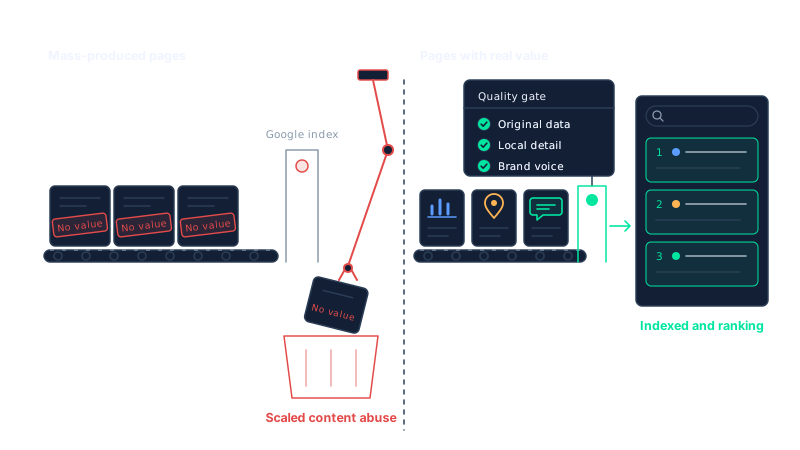
Stuffing FAQ schema onto every page, or writing every paragraph as a direct question-and-answer pair, makes content feel mechanical and harder to read. Readers notice. So do quality systems. A 38-check quality gate catches exactly this kind of over-optimisation before it goes live.
Treating AI content as a shortcut to authority
Publishing high volumes of AI-generated content without grounding it in real brand detail, named authors and specific expertise is a fast route to being ignored by both search engines and AI models. What Google actually says about AI-generated content is worth reading before you scale anything. The signal that matters is authenticity, not volume. Brand profiles that capture real case studies, pricing and tone of voice give AI-generated content the specificity it needs to earn genuine visibility.
Frequently asked questions
Is GEO vs AEO vs SEO a real distinction, or just new names for the same thing?
They overlap significantly, but the distinctions are real. SEO targets search engine rankings. AEO targets the specific answer boxes and voice responses those engines surface. GEO targets citations inside AI-generated overviews from systems like ChatGPT or Gemini. Each has slightly different signals, but the underlying content quality requirement is the same.
Do I need a separate content strategy for AI search on my WordPress site?
No. A well-structured WordPress site with clear headings, specific factual content, consistent entity signals and proper structured data already satisfies most of what GEO and AEO require. You are refining an existing strategy, not building a parallel one. Most of the work is tightening what you already have rather than starting again.
How quickly do AI systems pick up new or updated content?
There is no reliable public timeline. AI models are trained on crawled data with varying cutoff dates, and retrieval-augmented systems update more frequently. Prioritise getting your content indexed correctly by Google first. If Google trusts and indexes your pages, AI systems that pull from live search are more likely to surface them.
Does internal linking affect AI visibility as well as SEO?
Yes. Strong internal linking helps search engines understand which pages carry the most authority on a topic, and that authority signal flows into what AI systems choose to cite. Orphan pages, meaning pages with no internal links pointing to them, are effectively invisible. Internal linking with orphan and overlap detection is one of the more overlooked technical factors in this space.
Should I use AI tools to write content aimed at AI systems?
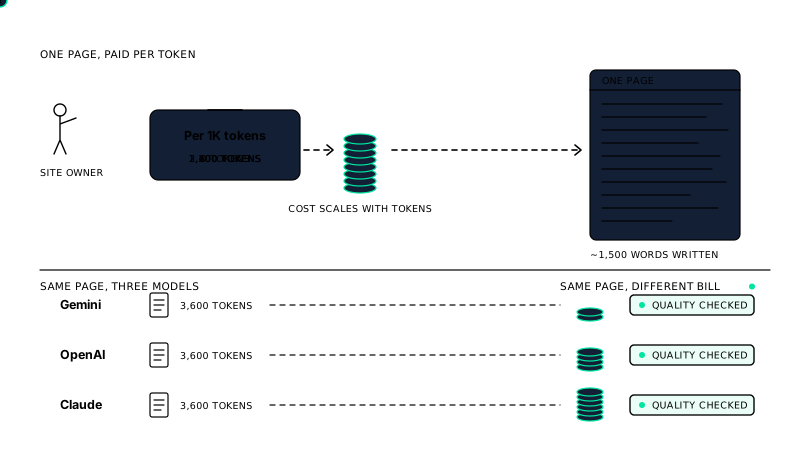
Only if the output is grounded in real, specific business detail. Generic AI content that lacks named expertise, real pricing, actual case studies or a consistent brand voice tends to be ignored by both Google and AI citation systems. Specificity is the signal. Volume without substance does not help. Read more on what AI content really costs per page before you scale.
The three disciplines are converging fast, and WordPress site owners who treat them as one joined-up content practice, rather than separate checklists, will be better placed as search continues to change. Get your fundamentals right, add structured data, keep your brand signals consistent and let content depth do the rest.
Writrex writes from your real business facts and checks every page before it publishes. Start with Writrex Lite for free.