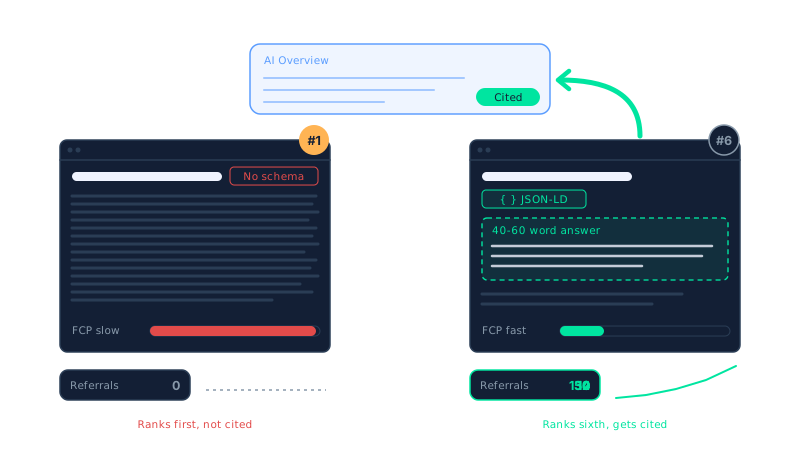
If you want to know how to rank in Google AI Overviews, the first thing to accept is that traditional ranking position matters far less than you might expect. Nearly half of all AI Overview citations, 47% to be precise, come from pages sitting below position five in standard organic results. A smaller site with a well-structured page can earn a citation ahead of a domain authority heavyweight.
The practical implication is significant. You do not need to outrank established competitors in the blue links to appear in the AI-generated summary at the top of the page. You need to structure your content so that Google’s AI can extract, trust and cite it cleanly.
This blueprint covers the on-page elements that drive citations: direct-answer blocks, semantic completeness, schema markup, page speed and a repeatable freshness system. Work through each section and you will have a page built for how search actually works in 2026, not how it worked in 2019.
Why position one no longer guarantees AI visibility
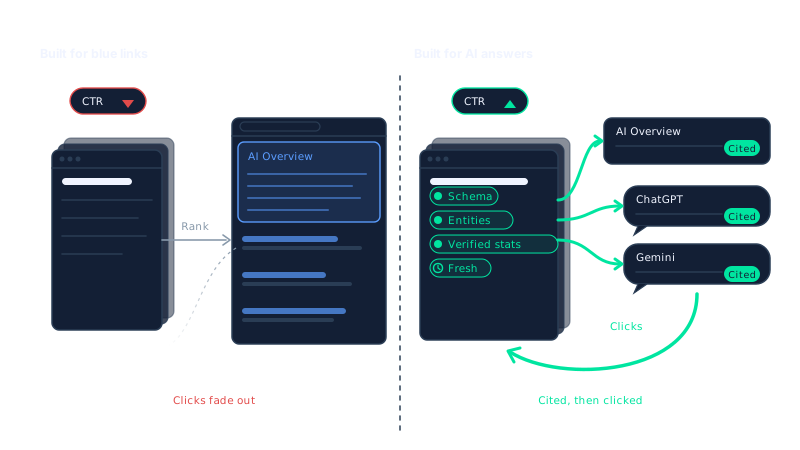
Position one click-through rates have already fallen from 28% to 19%, and searches that trigger an AI Overview carry an 83% zero-click rate compared to 60% for standard queries. Ranking first still brings traffic, but a smaller share of it than it once did.
What has changed is where Google pulls its cited sources. AI Overviews do not simply mirror the top organic result. They scan for the page that answers the query most completely and most clearly, regardless of where that page sits in the ranked list. A focused, well-organised page on a mid-sized site can beat a shallow page on a high-authority domain.
This shifts the effort from pure link acquisition toward page-level content quality, something every site owner can control directly. For a broader look at how AI systems are changing search behaviour, the post on GEO vs AEO vs SEO for WordPress site owners sets useful context.
What Google AI Overviews actually look for in a page
Three signals appear most strongly in the data: semantic completeness, structural clarity and freshness.
Semantic completeness means the page answers the primary question and the natural follow-up questions in one place. Content that scores highly on this measure is 4.2 times more likely to appear in an AI Overview than content that answers only the headline query and stops.
Structural clarity means a logical heading hierarchy, short paragraphs and, critically, a concise direct-answer block placed early in the page. Google’s AI needs to extract a quotable passage quickly. If the answer is buried inside dense prose, it often gets skipped.
Freshness is a harder signal to fake. AI assistants cite content that is on average 25.7% fresher than standard organic results. A page last updated two years ago competes poorly against a comparable page refreshed last month, even if the older page ranks higher in blue links.
Understanding how generative engine optimisation works for WordPress gives a practical foundation before you start rewriting pages to meet these criteria.
How to write 40-60 word direct-answer citation blocks
A citation block is a single paragraph placed immediately after an H2 or H3 that answers the section’s core question in plain, complete sentences. Google’s AI needs a passage it can lift and quote without editing. If that passage does not exist, the AI either skips your page or paraphrases it loosely, which means no citation link back to you.
The target length is 40 to 60 words. Shorter than 40 words and the answer often lacks enough context to stand alone. Longer than 60 words and the AI tends to truncate it, which can distort your meaning.
A practical structure for each block:
- State the direct answer in the first sentence.
- Add one sentence of supporting context or qualification.
- Close with a concrete detail, a number, a condition or a named example.
For example, if your page covers image optimisation, the citation block under “How does image format affect page speed?” might read: “WebP images are typically 25-35% smaller than equivalent JPEGs at the same visual quality. Serving WebP via a WordPress plugin like Imagify or ShortPixel reduces payload without changing your workflow. Pages with lower image weight load faster and qualify for better Core Web Vitals scores.” That is 46 words, self-contained and quotable.
Write one citation block per major section. Do not bury it after three paragraphs of background. Place it first, then expand below it for readers who want the detail.
Building semantic completeness into a single page
Semantic completeness is what separates a page that earns citations from one that merely ranks. A semantically complete page answers the primary question and the realistic follow-up questions a reader would have, all without forcing them to leave.
To build this, start with a simple question map. Write down your main query, then list every question a reasonably informed reader might ask next. Group those questions into three to five themes and give each theme its own H2. Each H2 section gets its own citation block, plus enough supporting detail to resolve the question fully.
This approach matters because content scoring high on semantic completeness is 4.2 times more likely to appear in an AI Overview. A page that answers only the headline query and stops is structurally incomplete from the AI’s perspective, even if it ranks well in blue links.
Avoid splitting related questions across multiple thin pages to chase keyword variations. One thorough page consistently outperforms three shallow ones for AI citation purposes. The post on duplicate content in AI-generated pages explains why fragmentation hurts rather than helps in this context.
Finally, make sure every claim on the page connects logically to the next. AI systems follow the reasoning chain through a page. Gaps in logic, or sections that feel bolted on, reduce the confidence the AI places in your content as a reliable source. If you are using AI tools to help draft or refresh pages, the 38-check quality gate in Writrex is designed to catch exactly these structural gaps before a page is published.
JSON-LD schema markup that supports AI citation
Schema markup does not directly force Google to cite your page, but it does help AI systems map the entities on your page cleanly and confidently. When the structure is ambiguous, AI models default to sources where the relationships between topic, author, organisation and content type are explicit.
For most WordPress pages, four schema types cover the majority of use cases:
- Article – signals content type, author, publish date and last modified date.
- FAQPage – marks up question-and-answer pairs so AI systems can extract them directly.
- Organization – ties your domain to a named entity with a consistent identity.
- Product – for WooCommerce pages, confirms price, availability and description in a machine-readable format.
Place all of this in a single <script type="application/ld+json"> block in the page <head>. Avoid duplicating properties across multiple schema blocks on the same page, as conflicting signals reduce confidence. Keep the dateModified field accurate, because AI systems cross-reference it against the freshness of the content itself. A stale dateModified on a recently updated page is a mismatch that undermines trust.
The structured data features in Writrex handle this automatically, outputting clean JSON-LD tied to your brand profile and content type without manual editing.
Page speed benchmarks that affect citation frequency
Speed is not a soft ranking signal here – the data is specific. Pages with a First Contentful Paint under 0.4 seconds average 6.7 AI citations. Pages loading slower than 1.13 seconds average just 2.1. That is a three-fold difference driven entirely by how quickly the AI crawler can confirm your content exists and is stable.
On WordPress, the fastest wins tend to come from three areas:
- Serving images in WebP format and lazy-loading anything below the fold.
- Using a CDN to reduce time-to-first-byte for visitors and crawlers outside your server’s region.
- Eliminating render-blocking scripts, particularly third-party tag managers that fire before the main content loads.
Run your pages through Google PageSpeed Insights and treat the FCP figure as your target metric, not the overall score. A page can score 80 and still have an FCP above 1 second if the score is propped up by other factors.
Internal linking also plays a role here. Flat link structures, where important pages are reachable within two clicks from the homepage, help crawlers confirm page authority without following long chains. The internal linking tools in Writrex include orphan and overlap detection, which keeps your link graph clean and prevents citation-worthy pages from being buried.
A 30-day content freshness system
AI assistants cite content that is, on average, 25.7% fresher than standard organic results. Pages updated every 30 days earn 3.2x more AI citations than those left untouched. That is not a coincidence. Freshness signals to the model that the information is current and that someone is actively maintaining the page.
A 30-day refresh cycle does not mean rewriting everything. It means making meaningful, verifiable updates that change the page’s content and its dateModified schema value. Here is a practical rotation:
- Week 1: Review the direct-answer blocks. Are the figures still accurate? Has anything changed in your industry that makes a claim outdated? Update the text and the date.
- Week 2: Expand a supporting section. Add a new question-and-answer pair to your FAQPage schema if a common query has emerged in Search Console.
- Week 3: Check internal links. Has a newer page on your site answered a related question more thoroughly? Update the link to point there.
- Week 4: Audit the meta description and title tag against current search intent. Small wording changes here can shift click-through rates without touching the body content.
Build this into a simple spreadsheet: page URL, last updated date, next scheduled review. Treat it like editorial maintenance, not a technical task.
Internal linking and entity mapping for AI crawlers
When you think about how to rank in Google AI Overviews, internal linking is often underestimated. AI models do not just read individual pages. They build a picture of your site’s topical authority by tracing how pages connect to each other.
A flat link structure, where key pages sit within two clicks of the homepage, signals that those pages are important. But the anchor text matters just as much as the structure. Generic anchors like “read more” tell a crawler nothing. Descriptive anchors, for example “how to find and fix orphan pages on a WordPress site,” confirm the topic of the destination page and reinforce the entity relationship between the two.
Orphan pages are a specific problem for AI citation. A page with no inbound internal links is effectively invisible to the entity graph the model is building. It may rank, but it will rarely be cited. Audit your site regularly and connect isolated pages to relevant cluster content.
For topic clusters, link bidirectionally. If your pillar page links to a supporting article on digital PR for AI visibility, that article should link back to the pillar. This creates a closed loop that reinforces the relationship between entities rather than leaving the model to infer it.
Keep your link graph honest. Overlapping anchor text across multiple pages pointing to different destinations confuses entity mapping. Each page should own a clear topic, and your internal links should reflect that consistently.
Measuring AI referral traffic and citation performance
Most analytics setups are not built to track AI citation performance out of the box. That gap matters, because if you cannot see which pages are being cited and what traffic they are sending, you cannot improve your strategy.
Start with Google Search Console. Filter performance data by search type and look for impressions and clicks tied to AI Overview appearances. Google surfaces this under the “Search type” filter as “AI Overviews.” Pages appearing there are your citation candidates. Note which queries trigger the feature and which of your pages are being pulled in.
In Google Analytics 4, create a segment for sessions where the source contains “google” and the medium is “organic,” then look for unusually high engagement rates and low bounce rates among that group. AI referral traffic converts at a significantly higher rate than standard organic traffic, so a cluster of high-engagement sessions from Google organic is often a signal that citation traffic is mixed into that channel.
For cleaner attribution, watch for referral sessions tagged with sources like “perplexity.ai,” “chatgpt.com,” or “claude.ai.” These are direct AI referrals and are trackable as standard referral traffic in GA4. Build a simple custom report that groups these sources together so you can monitor growth month on month.
Beyond analytics, run manual spot checks. Search your target queries in Google and note whether an AI Overview appears and whether your page is cited. Screenshot the result and log it against the page URL and the date. This gives you a longitudinal record that no tool currently provides automatically.
Track these metrics per page: citation appearances, referral sessions from AI sources, conversion rate for those sessions, and the page’s last updated date. The last point connects directly to your freshness system. If a page drops out of citations after several weeks without an update, that is a clear signal to trigger your next refresh cycle.
For a broader look at how AI search is reshaping the way site owners should think about visibility, the guide on agentic SEO, WordPress and WebMCP covers what the shift toward AI-driven crawling means in practice. And if your pages are generating AI content at scale, understanding how to scale AI content without triggering Google’s spam policies will help you keep that output citation-worthy rather than penalised.
Frequently asked questions
Do you need to rank on page one to get cited in Google AI Overviews?
No. Nearly half of all Google AI Overview citations come from pages ranking below position five in traditional organic search. Semantic completeness, clear heading structure, and concise direct-answer blocks carry more weight than legacy domain authority or raw ranking position. A well-structured page on a smaller site can outperform a poorly organised page on a large one.
How long should a direct-answer citation block be?
Aim for 40 to 60 words. That range is long enough to give a complete, self-contained answer and short enough for an AI system to extract cleanly. Place the block immediately after the relevant heading, lead with the answer rather than context, and avoid hedging language that dilutes the signal. Treat each block as a standalone fact the AI can quote directly.
How often should you update a page to stay cited?
Pages updated every 30 days earn significantly more AI citations than static content. AI assistants favour fresher sources: cited pages are on average 25.7% fresher than standard organic results. A monthly review cycle, where you update statistics, expand thin sections, and refresh the published date with genuine changes, is the minimum to stay competitive in citation results.
Which JSON-LD schema types matter most for AI citation?
Article, FAQ, Organization, and Product are the four types that map most cleanly to the entities AI systems look for. Use Article on editorial pages, FAQ where you answer discrete questions, and Organization on your homepage and contact page. Keep your markup flat and valid. Nested or broken schema creates ambiguity that reduces rather than improves your citation chances.
How do you know if a page is being cited in AI Overviews?
Filter Google Search Console performance data by the “AI Overviews” search type to see which pages are appearing. Run manual spot checks on your target queries and log the results by date and URL. In GA4, monitor referral sessions from sources such as perplexity.ai and chatgpt.com as a separate segment alongside your organic data.
Applying all of these changes across a large WordPress site is a significant amount of work if you are doing it manually. Getting the on-page structure right from the first draft, with proper answer blocks, schema, and internal links already in place, removes most of that rework. If you want a practical starting point for building pages that meet these standards from the outset, the guide on how to fix WordPress SEO issues with AI without losing control covers the diagnostic steps clearly, and the meta titles and descriptions audit checklist is a useful companion for tightening the signals AI systems read first.
Writrex writes from your real business facts and checks every page before it publishes. Start with Writrex Lite for free.