Agentic SEO, WordPress and WebMCP are no longer future concerns. As of early 2026, AI agents are actively booking appointments, comparing products and completing purchases on behalf of users, often without a human ever visiting a search results page. If your WordPress site cannot be read and acted on by these agents, it gets skipped entirely.
The shift is structural, not cosmetic. Traditional SEO optimised pages for human eyes and search engine crawlers. Agentic SEO optimises for software that needs to call your site like an API, extract clean data and take action. That requires a different technical foundation, and most WordPress sites do not have it yet.
This guide covers what is changing, why Chrome 146 and WebMCP make 2026 the year to act, and what you need to do to your WordPress site before AI agents route around you permanently.
Why AI agents are replacing human search sessions
A human search session follows a predictable pattern: query, results page, click, read, decide. AI agents collapse that chain. A user tells their agent to find the best plumber in Leeds available on Saturday morning, and the agent queries multiple sources, checks availability, reads pricing and books, all without the user touching a browser.
This is not a niche behaviour. According to Apptopia data cited in 2026, ChatGPT’s share of AI app usage dropped from roughly 69 to 86 percent in early 2025 to around 45 to 64 percent by early 2026, as Google Gemini roughly quadrupled its share. Around 20 percent of users are now actively relying on multiple AI platforms simultaneously. More agents, more platforms, more autonomous task execution.
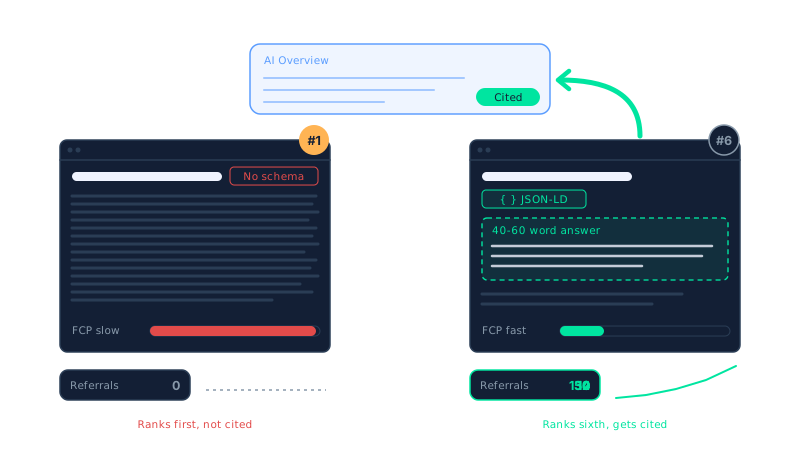
For site owners, the practical consequence is stark. A site that ranks well in traditional search but cannot serve structured, machine-readable data to an agent is invisible at the moment of execution. Visibility has moved from the search results page to the agent’s decision layer. Understanding the difference between GEO, AEO and traditional SEO is a good starting point for framing that shift.
What WebMCP is and why Chrome 146 matters
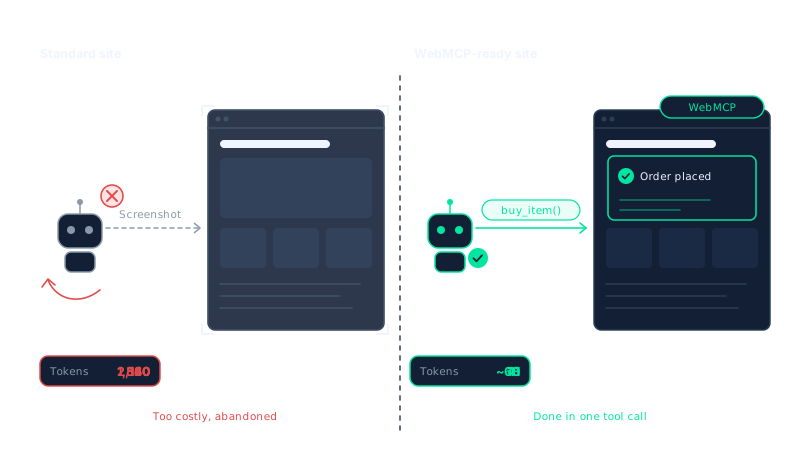
WebMCP, formally called the Model Context Protocol for the web, is a standard that allows websites to expose structured tools directly to AI agents. Instead of an agent taking a screenshot of your page and parsing it visually, your site declares what it can do, what data it holds and how an agent should interact with it. The agent calls those tools directly.
Developed with support from Google and Microsoft, WebMCP shipped in early preview with Chrome 146 in February 2026. Chrome 146 is the first mainstream browser to support the protocol natively, which means the infrastructure for agent-to-site communication is already in place and already in use.
For WordPress developers, the relevant question is not whether WebMCP matters but how quickly it will become a baseline expectation. Protocols backed by Google and Microsoft tend to move from early preview to widespread adoption faster than the SEO community expects. The sites that implement clean structured data and machine-readable endpoints now will have a measurable head start. Structured data output is one of the clearest technical foundations you can put in place today to prepare for that transition.
The 89% token efficiency gap that decides which sites agents use
Token cost is the hidden currency of the agentic web. When an AI agent visits a site that lacks structured tools, it falls back on visual scraping: taking a screenshot, parsing it, deciding what to do next. Each of those actions consumes over 2,000 tokens. Multiply that across a multi-step task like comparing three plumbers, checking availability and reading pricing, and the cost escalates fast.
WebMCP changes the arithmetic entirely. Structured tool calls replace screenshots, consuming roughly 20 to 100 tokens per action. That is an approximately 89% reduction in token usage per interaction.
This is not just an efficiency footnote. Agent routing algorithms are cost-sensitive by design. When one site costs 2,000 tokens to query and another costs 50, the agent will consistently prefer the cheaper path, all else being equal. A WordPress site without WebMCP-compatible structured data is not just harder to read. It is actively more expensive for an agent to use, and agents will route around it.
The practical implication is that technical SEO for agentic search is partly an economics problem. Clean, machine-readable data reduces friction and cost for the agent. Sites that reduce that cost get chosen more often.
How the discovery-to-execution shift changes what SEO means
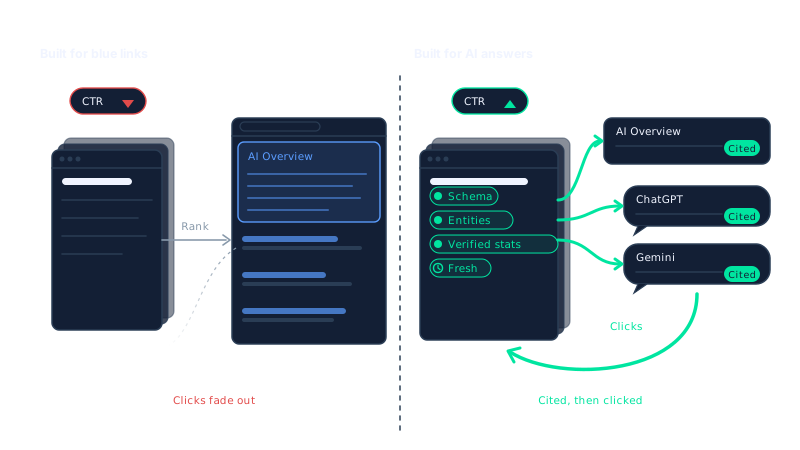
Traditional SEO optimises for discovery: get the page in front of a human, who then decides what to do. Agentic SEO optimises for execution: give an agent everything it needs to complete a task on a user’s behalf, without a human in the loop.
Sites without machine-readable schemas, clean APIs, or structured product and availability data do not just rank lower in this model. They get bypassed entirely. An agent booking a restaurant cannot work with a PDF menu and a phone number buried in a footer. It needs structured data it can read and act on.
This is a meaningful shift for WooCommerce store owners in particular. If your product data lives only in visual page templates, an AI shopping agent comparing prices across three suppliers will skip you and move to a competitor whose data is structured and accessible. Understanding the distinction between GEO, AEO and traditional SEO helps clarify exactly where your optimisation effort now needs to go.
Keyword placement matters far less than entity clarity in this environment. A 2026 Surfer analysis of 30,000 pages across 1,000 queries found that early keyword placement ranked 14th out of 15 factors in predicting AI citation likelihood, with near-zero correlation. Semantic relevance and clear entity relationships were what drove retrieval. For WordPress sites aiming to be cited by AI, that means investing in structured, entity-rich content rather than chasing keyword density.
Schema markup: the non-negotiable foundation for agentic SEO
If an AI agent cannot read your data without rendering a page visually, you have already lost the economics argument. Schema markup is how you make your data legible to agents at minimal token cost.
For WordPress and WooCommerce sites, the priority types are straightforward:
- Product schema – name, price, currency, availability, SKU and condition. An agent comparing suppliers across three tabs needs all of this in structured form, not scattered across a visual template.
- LocalBusiness or Service schema – address, opening hours, service area and accepted payment methods. A booking agent cannot infer these from a styled contact section.
- FAQPage and HowTo schema – these help agents extract procedural answers without parsing prose.
- Review and AggregateRating schema – agents ranking options by quality need machine-readable scores, not star images in a slider.
The markup needs to be accurate and complete. Partial schema, where price is present but availability is missing, forces the agent to fall back on scraping or skip your site. Getting product descriptions built from real product data matters here because schema populated from vague copy will be vague schema.
JSON-LD is the correct format. It sits in the document head, separate from your visual markup, and is the format Google’s documentation recommends for structured data.
Clean site architecture and machine-readable data for agents
Schema covers the data layer. Site architecture covers how an agent moves through your site once it arrives.
Agents do not browse the way humans do. They follow links programmatically, parse sitemaps and look for consistent URL patterns. A site with logical, flat URL structures, a clean XML sitemap and no orphaned pages is significantly easier for an agent to traverse efficiently.
For WordPress sites, that means:
- Consistent URL structures, such as
/services/plumbing/or/products/category/item/, rather than arbitrary slugs. - An XML sitemap that accurately reflects your current content, with no dead URLs included.
- Internal links that connect related content logically. Orphan pages – pages with no internal links pointing to them – are invisible to agents following link graphs.
- Robots.txt and meta robots directives that are intentional. Blocking the wrong paths will exclude structured data from agent access.
- Page speed that does not punish agents hitting multiple URLs in sequence. Slow server response times compound across multi-step agent tasks.
For WooCommerce stores specifically, ensure your product catalogue is accessible without JavaScript rendering where possible. Many agent frameworks do not execute JavaScript. If your prices and stock levels only appear after a client-side render, a shopping agent will see an empty page.
The underlying principle across both schema and architecture is the same: reduce the work an agent has to do to get reliable, complete information from your site. Every extra step costs tokens and increases the probability the agent routes elsewhere.
A practical WordPress checklist for WebMCP readiness
The sections above cover the principles. This checklist turns them into actions you can work through on your WordPress or WooCommerce site before agent traffic becomes a meaningful share of your referrals.
- Install and validate JSON-LD schema. Use Google’s Rich Results Test and Schema.org’s validator. Fix any missing required properties, especially
price,availability,areaServedandopeningHours. - Audit your XML sitemap. Remove dead URLs, redirect chains and pages you have set to
noindex. Submit the clean version to Google Search Console. - Check JavaScript dependency on critical data. Load your product and service pages with JavaScript disabled. If prices, stock levels or booking options disappear, that content is invisible to most agent frameworks. Move it into server-rendered HTML or your JSON-LD block.
- Review robots.txt deliberately. Confirm you are not accidentally blocking
/wp-json/or any path that exposes structured endpoints agents might call. - Flatten URL structures where possible. Deeply nested URLs such as
/shop/category/subcategory/product-name/variation/add traversal cost. Aim for three levels or fewer. - Fix orphan pages. Any page with no internal links pointing to it sits outside an agent’s link graph. Writrex’s internal linking and orphan detection flags these automatically so you can connect or consolidate them.
- Test page speed under sequential load. Agents hit multiple URLs in rapid succession. A server that throttles after a few fast requests will time out mid-task.
- Prepare a WebMCP tool manifest. Even a basic manifest that exposes search, product lookup and availability endpoints puts your site ahead of the majority that have none.
Agentic SEO for WordPress and WebMCP readiness is not a single plugin toggle. It is a combination of clean data, clean architecture and intentional configuration.
Entity clarity over keyword placement: what the data shows
A 2026 Surfer analysis of 30,000 pages across 1,000 queries found that early keyword placement ranked 14th out of 15 factors for AI citation likelihood, with near-zero correlation. Semantic relevance and clear entity relationships were the dominant signals.
That finding matters practically. An AI agent retrieving information about a plumber in Bristol does not scan for the phrase “plumber Bristol” in your H1. It looks for a clearly defined entity: a business with a name, a service type, a geographic area, contact details and verifiable attributes. If those relationships are explicit in your schema and your prose, the agent can resolve your entity confidently. If they are buried in keyword-stuffed copy, the agent either misreads them or skips to a site where the data is unambiguous.
Entity clarity means writing and marking up your content so that the who, what, where and how are stated directly, not implied. For a service business, that is your LocalBusiness or ProfessionalService schema combined with prose that names your services specifically rather than generically. For a WooCommerce store, it is Product schema with brand, GTIN, condition and category all populated, not left blank.
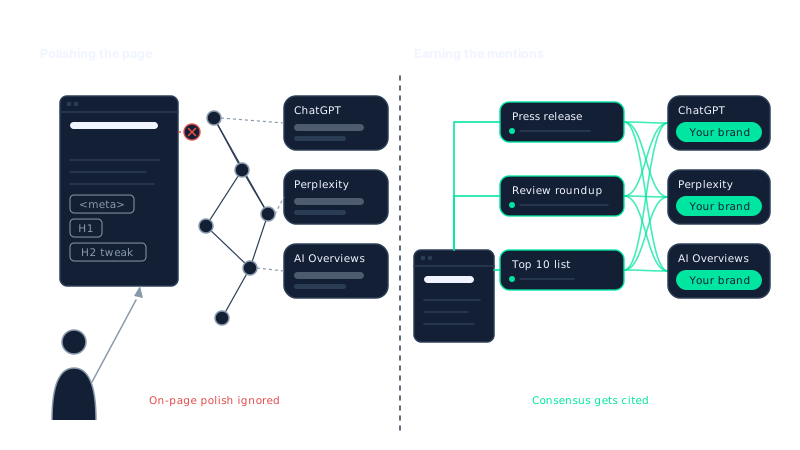
If you want a broader view of how AI retrieval differs from traditional ranking, the relationship between earned media and AI visibility is worth reading alongside this checklist. Citations and entity signals work together.
The practical shift is this: stop optimising sentences for keyword density and start optimising your data model for entity completeness. Those are different tasks, and the second one is what agentic systems reward.
Multi-platform AI distribution and why one agent is not enough
There is a temptation to treat agentic SEO as a Google problem, or a ChatGPT problem. It is neither. According to Apptopia data cited in 2026, ChatGPT’s share of AI app usage fell from roughly 69 to 86 percent in early 2025 to around 45 to 64 percent by early 2026, as Google Gemini roughly quadrupled its share. Around 20 percent of users were actively relying on multiple AI platforms at once.
That fragmentation is not a temporary blip. It reflects a market where different agents are better at different tasks. A user might ask Gemini to compare broadband deals, use a Claude-powered assistant to draft a brief, and rely on a Perplexity agent to check product availability before purchasing. Each of those agents has its own retrieval logic, its own preferred data formats and its own way of resolving entities.
The implication for WordPress and WooCommerce site owners is straightforward: optimising for one agent’s preferences is not enough. A site that surfaces cleanly in ChatGPT’s retrieval but presents ambiguous schema to Gemini will lose half its potential agentic traffic before a human ever sees a result.
The practical response is to focus on the common layer that all agents share. Structured data using Schema.org vocabularies is readable by every major agent. Clean, crawlable architecture is not agent-specific. A WebMCP tool manifest benefits any agent that supports the protocol, regardless of who built it. These are not platform-specific optimisations. They are baseline requirements for the multi-agent environment that is already here.
This also means thinking carefully about how your brand is represented across different data sources. An agent cross-referencing your business details against third-party directories, review platforms and knowledge graphs will build a composite picture. If your name, address, service categories or product identifiers are inconsistent across those sources, entity resolution fails, and the agent routes elsewhere.
Understanding how meta titles and descriptions feed into AI retrieval signals is one practical starting point. Pair that with consistent structured data across every page, and you give every agent, on every platform, the same unambiguous picture of what your site offers.
Frequently asked questions
Does WebMCP replace schema markup, or do both still matter?
Both still matter, and they serve different purposes. Schema markup tells agents what your content means. WebMCP exposes structured tools that agents can call to take action, such as checking availability or retrieving a price. A site with clean schema but no WebMCP tool manifest is still far ahead of a site with neither.
Is agentic SEO only relevant for e-commerce sites?
No. Any site where a user might want an agent to complete a task benefits from agentic readiness. Service businesses, local tradespeople, SaaS products and content publishers all have information that agents retrieve and act on. If your site answers questions or enables decisions, agentic SEO applies to you.
How do I know if my WordPress site is already machine-readable enough for AI agents?
Start by validating your structured data in Google’s Rich Results Test and Schema Markup Validator. Then check whether your product or service pages expose clean, consistent data: prices, identifiers, availability and entity relationships. If an agent cannot resolve what you sell, where you operate and who you are from your markup alone, there is work to do.
Will optimising for AI agents hurt my traditional search rankings?
It should not, and in most cases it helps. Clean architecture, accurate structured data and strong entity clarity are the same signals that traditional crawlers reward. The practices that make a site agent-friendly, including fixing common WordPress SEO issues and tightening your data model, reinforce rather than conflict with conventional ranking factors.
How quickly is this shift happening?
WebMCP shipped in early preview with Chrome 146 in February 2026. Agent usage is already fragmenting across platforms. This is not a future concern to revisit in a year. Sites that build machine-readable foundations now will compound that advantage as agent traffic grows, while those waiting for a clear tipping point will be catching up.
Agentic SEO for WordPress is not a single fix. It is a set of compounding decisions: accurate schema, clean architecture, consistent entity data and, where possible, a WebMCP tool manifest. Each layer makes your site easier for agents to read, trust and act on. The sites that treat this as infrastructure rather than a trend will be the ones agents consistently choose. If you want to understand how scaling AI content responsibly fits into that broader strategy, that is a practical next step.
Writrex writes from your real business facts and checks every page before it publishes. Start with Writrex Lite for free.