Generative Engine Optimization for WordPress is no longer a future concern. It is the work you need to do right now if you want your site to appear in ChatGPT answers, Google AI Overviews, and Gemini responses, rather than being silently skipped while a competitor gets cited instead.
The core problem is simple: AI search tools summarise the web and present one answer. If your content is not structured, fresh, and credibly sourced, you will not be in that answer. Your page may still rank in the traditional blue-link results, but fewer people are seeing those results at all.
This guide covers what has changed, why it matters for WordPress site owners specifically, and what you can do about it section by section.
Why organic clicks are shrinking in 2026
The numbers are stark. Between January and April 2026, 68.01% of US Google searches ended without a single click, up from 60.45% in 2024. That means more than two thirds of searches now resolve on the results page itself, inside an AI summary, a featured snippet, or a knowledge panel.
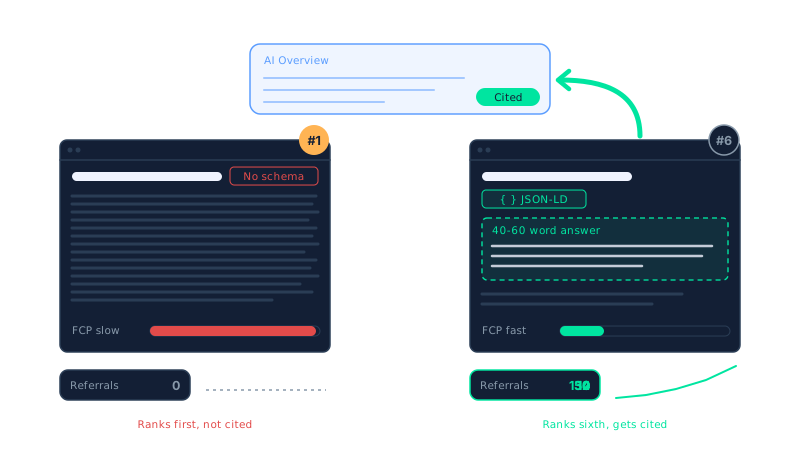
The click loss is even sharper when AI Overviews appear. When Google surfaces an AI Overview for a query, organic click-through rates for top-ranking pages drop by roughly 58% to 61%. Ranking first no longer guarantees meaningful traffic if an AI summary sits above your result and answers the question completely.
The scale of these AI platforms makes this unavoidable. Google reported over 1 billion monthly active users for AI Mode in 2026, and ChatGPT surpassed 900 million weekly active users in early 2026. These are not niche tools used by early adopters. They are mainstream search behaviour.
GEO vs. SEO: what actually changes
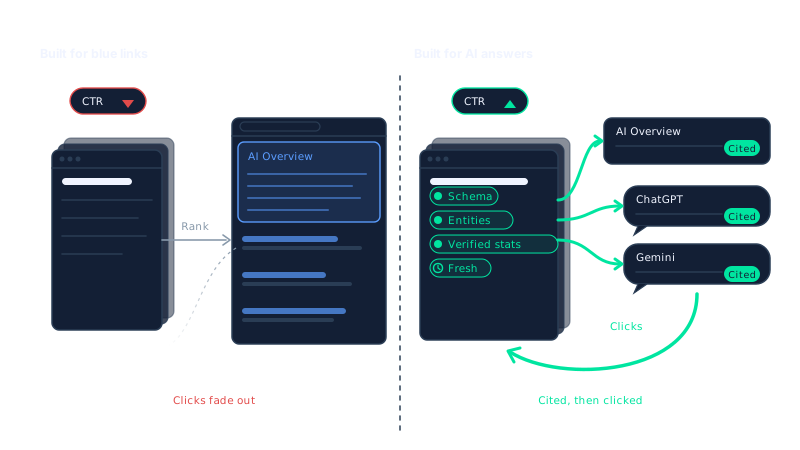
Traditional SEO is built around signals that help a crawler rank a page: backlinks, keyword placement, page speed, and technical health. Those signals still matter, but they were designed for a system that sends users to your page. Generative Engine Optimization targets a different outcome: being the source an AI model quotes directly, often without the user visiting your site at all.
The practical differences are meaningful:
- SEO optimises for ranking position. GEO optimises for citation in a generated answer.
- SEO rewards keyword density and link authority. GEO rewards clear entity definition, verifiable facts, and expert attribution.
- SEO treats a page as static until you decide to update it. GEO treats content freshness as an active ranking signal, not a nice-to-have.
Neither replaces the other. A page that ranks well in blue-link results is more likely to be in the training or retrieval pool that AI models draw from. But ranking alone is not enough. You also need the content signals that make an AI model confident enough to quote you. That is a different discipline, and it starts with understanding how these models choose their sources. For a fuller comparison of the three overlapping frameworks, the plain guide to GEO vs AEO vs SEO for WordPress site owners is worth reading alongside this article.
How AI models decide which sources to cite
AI models do not rank pages the way a search crawler does. They pull from a retrieval pool, then assess which sources are clear, credible, and specific enough to quote with confidence. Understanding that distinction changes how you write.
Controlled GEO testing has produced some of the clearest evidence available. Adding relevant expert quotations to a page boosts generative engine visibility by 41%. Adding verified statistics raises it by 31%. Keyword stuffing, by contrast, performs worse than making no changes at all. The model is not looking for density signals. It is looking for citable material.
What that means practically: a page that states a named expert’s position on a specific topic, backed by a verifiable figure, gives a language model something it can reproduce accurately and attribute cleanly. A page that repeats a target phrase twelve times gives it nothing useful.
Three content signals consistently improve citation likelihood:
- Named attribution. Quote a real person with a title and organisation, not a vague industry consensus.
- Verifiable figures. Specific numbers from identifiable sources outperform general claims.
- Clear scope. A page that answers one question thoroughly is more citable than a page that covers ten questions shallowly.
Entity structure: making your brand unambiguous to LLMs
Language models build a picture of the world from entities: named things, places, people, organisations, and the relationships between them. If your brand is ambiguous or inconsistently described across the web, a model has no reliable entity to cite. It will default to a competitor whose identity is cleaner.
Entity clarity starts on your own site. Your business name, location, founding context, and area of specialism should appear consistently across your homepage, About page, and contact details. Inconsistencies, such as trading under two slightly different names or describing your services differently on each page, create ambiguity that models resolve by ignoring you.
Structured data makes this explicit. A LocalBusiness or Organization schema block tells a model your name, URL, address, and what you do without requiring it to infer those facts from prose. Writrex generates and maintains this structured data automatically, keeping it consistent as your content changes. You can see exactly what it produces in the structured data feature overview.
Beyond your own site, consistency matters off-site too. Your Google Business Profile, industry directories, and any press mentions should all use the same name and description. A model that sees your brand described identically in ten independent places treats that as a strong entity signal. Variation across those same ten places does the opposite.
For generative engine optimization on WordPress, entity structure is the foundation everything else sits on. Statistics and expert quotes only help if the model already knows which entity produced them.
Statistics and expert quotes: the content signals that work
Once a language model has a clear entity to attribute, it needs something worth attributing. That is where the content of individual pages matters most.
Controlled generative engine optimization testing shows that adding relevant expert quotations boosts AI visibility by 41%, while adding verified statistics raises it by 31%. Those are not marginal gains. They reflect something structural about how large language models are trained: they learn to reproduce claims that are specific, attributable, and internally consistent.
In practice, this means three things for your WordPress content.
- Name your sources. “Industry experts suggest” is not citable. “Jane Smith, Head of Procurement at Acme Manufacturing, says…” is. The model can form a clean attribution. Use real names, real titles, and real organisations.
- Anchor every claim to a number. Vague assertions disappear inside a summary. A specific figure, even a modest one, gives the model a discrete fact to reproduce and cite.
- Scope each page tightly. A page that answers one question thoroughly outperforms a page that skims ten. Generative models favour depth over breadth because a shallow page rarely contains enough verifiable detail to cite safely.
If your content currently leans on general claims and implied consensus, a straightforward audit will surface the gaps. The meta titles and descriptions audit checklist covers on-page signals worth reviewing at the same time.
Structured data and schema for AI visibility
Prose gives a model facts to read. Schema gives it facts it does not have to interpret. That distinction matters more as AI summaries become the default answer surface.
A properly implemented Organization or LocalBusiness schema block states your name, URL, address, and service area in a machine-readable format. The model does not need to infer those details from a paragraph. It reads them directly. FAQPage, Article, and HowTo schema serve a similar function: they tell the model what type of content it is reading and what the intended answer structure looks like.
For generative engine optimization on WordPress, the practical risk is inconsistency. A schema block that describes your business differently from your About page, or that falls out of date when you update your services, actively undermines entity clarity. Keeping structured data synchronised with live content is not a one-time task.
The guide to fixing WordPress SEO issues with AI covers how to audit existing schema for errors and conflicts, which is a sensible starting point before adding new markup.
Prioritise schema types that match what AI models are most likely to surface: organisation identity, frequently asked questions, and step-by-step processes. Add markup only where the underlying content genuinely supports it. A HowTo block on a page that does not actually walk through steps will confuse a model rather than help it.
Content freshness: why quarterly updates are now non-negotiable
Structured data and strong citations get you cited. Staying cited is a different problem entirely.
Pages that are not updated at least once every quarter are three times more likely to lose their AI Overview citations than pages that are kept current. That figure reflects how generative models treat information age: a claim that was accurate in 2024 may be flagged as stale by 2026, and the model will quietly prefer a fresher source instead.
This is a meaningful shift from traditional SEO, where an evergreen page could hold a first-page ranking for years with minimal maintenance. Generative engine optimization for WordPress demands a different rhythm. AI systems are trained and updated on rolling data. If your page has not changed since the last training cycle, a competitor who updated theirs last month may simply replace you.
Quarterly updates do not mean rewriting from scratch. In most cases, the work is targeted:
- Replace any statistics that now have a more recent equivalent.
- Check that named sources, job titles, and organisations are still accurate.
- Add a short section addressing any question the topic has developed since the last update.
- Confirm that your schema still matches the live content on the page.
Set a recurring calendar reminder. Treat it like a billing cycle, not a creative project.
Brand mentions, unlinked citations, and off-site signals
Most WordPress site owners focus almost entirely on backlinks when thinking about authority. For AI visibility, that instinct is only partially right.
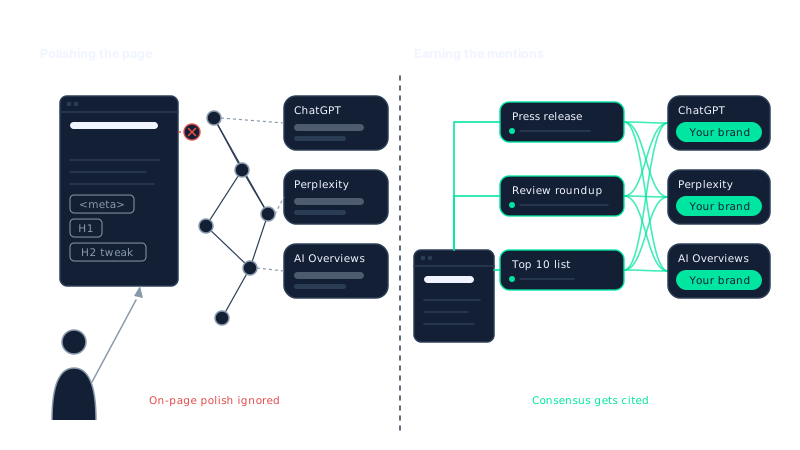
Across 75,000 studied brands, unlinked web mentions correlate roughly three times more strongly with AI Overview visibility than traditional backlinks do. A local newspaper article that names your business without linking to it, a forum post recommending your service, a podcast transcript that quotes your founder: these carry real weight with generative models, even though they pass no PageRank.
The reason is entity recognition. When an LLM sees your brand name appear consistently across independent sources, in different contexts, with consistent details, it builds confidence that the entity is real and credible. A backlink tells Google one site vouches for another. A pattern of unlinked mentions tells a model that real people, in real situations, refer to this brand without being prompted by a hyperlink.
Practical steps to build this signal:
- Write for industry publications, local press, and niche newsletters, even without a link back.
- Get your business listed and described accurately on directories, review platforms, and trade association pages.
- Encourage customers to mention your business by name in reviews, not just leave a star rating.
- Participate in online communities where your audience already gathers. Consistent, named contributions build mention volume over time.
On-site, make sure your brand name, location, and core service descriptions are consistent everywhere they appear. Inconsistency between your website, your Google Business Profile, and third-party listings creates entity ambiguity, which is exactly what causes a model to hedge or omit you from a summary. The guide to building local landing pages without doorway-page risk covers how to maintain that consistency at scale without creating thin or duplicated content across location pages.
If you are producing content regularly and want to ensure each piece carries accurate brand details, real pricing, and consistent tone before it goes anywhere near a search index, Writrex brand profiles keep that source-of-truth information attached to every piece the plugin generates, reducing the risk of the kind of inconsistency that quietly erodes entity clarity over time.
A practical GEO audit checklist for WordPress sites
Everything covered so far, entity clarity, verified statistics, expert quotations, schema markup, quarterly refreshes, and off-site mentions, only works if it is actually implemented consistently across your site. This checklist pulls those threads together into a repeatable process you can run every quarter.
Entity and brand consistency
- Confirm your business name, address, phone number, and core service description are identical on your website, Google Business Profile, and every major directory listing.
- Check that your About page names real people with real roles. Vague authorship weakens entity confidence for LLMs.
- Make sure every author bio links to a consistent online presence, a LinkedIn profile, a published portfolio, or a recognised industry page.
Content signals
- Audit your ten most important pages. Does each one contain at least one verifiable statistic with a named source? If not, add one.
- Check for expert quotations attributed to named individuals. Generic paraphrasing does not carry the same citation weight.
- Remove or rewrite any sections that read as keyword-heavy padding. Controlled GEO testing shows keyword stuffing performs worse than making no changes at all.
Technical and structural checks
- Validate your schema markup using Google’s Rich Results Test. Confirm that Organisation, Article, or Product schema reflects the current page content.
- Run an internal linking audit. Orphan pages, those with no internal links pointing to them, are effectively invisible to crawlers and to AI models building a picture of your site’s topical structure. The guide on how to find and fix orphan pages on a WordPress site walks through this in detail.
- Check that page titles and meta descriptions accurately reflect the content. Mismatches between metadata and body copy create trust signals that cut against citation.
Freshness and off-site signals
- Log the last-updated date for each priority page. Any page not touched in over three months goes on the refresh list immediately.
- Search for unlinked brand mentions using a tool like Google Alerts or a basic search operator. Note where your brand appears without a link and whether the surrounding context is accurate.
- Identify two or three external publications, local press outlets, or trade directories where your brand is absent or described inconsistently. Fix the inconsistencies first, then plan a contribution.
If you want a faster way to keep content aligned with accurate brand details across a large WordPress site, the 38-check quality gate in Writrex flags issues before content is published, catching the kind of factual drift and structural gaps that quietly reduce your chances of being cited.
Frequently asked questions
Is generative engine optimization for WordPress different from regular SEO?
They share foundations but differ in emphasis. Traditional SEO targets ranking signals like backlinks and keyword placement. Generative engine optimization for WordPress focuses on entity clarity, verifiable facts, expert attribution, and content freshness so that LLMs have enough confidence to cite your pages directly rather than paraphrase a competitor.
Do I need to rewrite all my existing content to get cited by AI?
No. Start with your ten most important pages. Add at least one verifiable statistic with a named source, attribute any expert claims to a real person, and tighten any sections that read as padding. A targeted refresh of existing content is faster and often more effective than starting from scratch.
How often should I update pages to stay in AI Overviews?
At minimum, every quarter. Pages not updated at least quarterly are three times more likely to lose AI Overview citations. Set a recurring calendar reminder, review the facts and statistics on each priority page, and update the published date only when the content itself has genuinely changed.
Does schema markup directly cause AI models to cite my site?
Not directly, but it removes ambiguity. Structured data tells AI systems what your organisation is, what a page covers, and who authored it. That clarity reduces the chance an LLM misattributes your content or skips it in favour of a source it can interpret with more confidence.
Are unlinked brand mentions actually worth pursuing?
Yes. Across 75,000 studied brands, unlinked brand mentions correlate roughly three times more strongly with AI Overview visibility than traditional backlinks. Consistent, accurate mentions in trade directories, local press, and niche publications build entity confidence for AI models even without a hyperlink pointing back to your site.
GEO is not a replacement for solid content and honest SEO practice. It is the next layer: entity clarity, cited facts, fresh pages, and a consistent brand presence across the web. Get those fundamentals right and AI systems have good reason to name you as a source. The guide on scaling AI content without triggering Google’s spam policies covers how to keep that output quality high at volume, and the internal linking and orphan detection features help ensure no page on your site sits invisible to crawlers or AI alike.
Writrex writes from your real business facts and checks every page before it publishes. Start with Writrex Lite for free.