Building product descriptions from product data – actual specs, dimensions, materials, use cases and stock information – produces copy that ranks better and converts more reliably than anything written from a blank page. The reason is simple: search engines reward specificity, and shoppers buy when they trust what they read.
Generic descriptions are everywhere. A product page that says “high-quality, versatile and perfect for any occasion” tells Google nothing it can index meaningfully, and tells a customer nothing they can act on. Real product data gives you the raw material to do better.
This article walks through how to pull that data into a repeatable content process – one that scales without sacrificing accuracy or brand voice.
Why generic product descriptions hurt your rankings and your sales
Thin, templated product copy creates two problems at once. First, it gives search engines very little to work with. Google’s systems try to understand what a page is about and whether it genuinely serves the person searching. A description that could apply to a thousand different products gives almost no signal either way.
Second, vague copy erodes trust at the moment it matters most. A shopper who lands on a product page already has intent. If the description does not answer their specific questions – what is it made from, what size is it, will it work with what they already own – they leave. That exit signals to Google that the page did not satisfy the query.
Duplicate descriptions compound both problems. Many WooCommerce stores pull manufacturer copy and publish it unchanged across dozens or hundreds of pages. That content already exists elsewhere on the web, so it adds no value to the index and no reason for a customer to buy from you rather than a competitor.
The fix is not to write more creatively. It is to write more specifically – and that requires real data as the starting point.
What counts as real product data
Real product data is any factual attribute that belongs to a specific product and cannot honestly be applied to another. Here are the most useful categories:
- Technical specifications: dimensions, weight, materials, capacity, compatibility, power requirements
- Identifiers: SKU, GTIN, MPN, model number
- Variants: colours, sizes, finishes and what distinguishes each one
- Use cases: who the product is designed for and what problem it solves
- Provenance: where it is made, certifications, standards it meets
- Commercial context: price, availability, warranty terms, shipping constraints
WooCommerce stores this data in product attributes, custom fields and variations. Most of it already exists in your database – it just has not been used to drive the copy yet.
Structured product data also has a second life beyond the description itself. When you mark it up correctly with schema, search engines can surface it in rich results – price, availability, ratings – directly in the SERP. That is worth doing alongside any copy work, and you can read more about how structured data works alongside product descriptions to extend that visibility further.
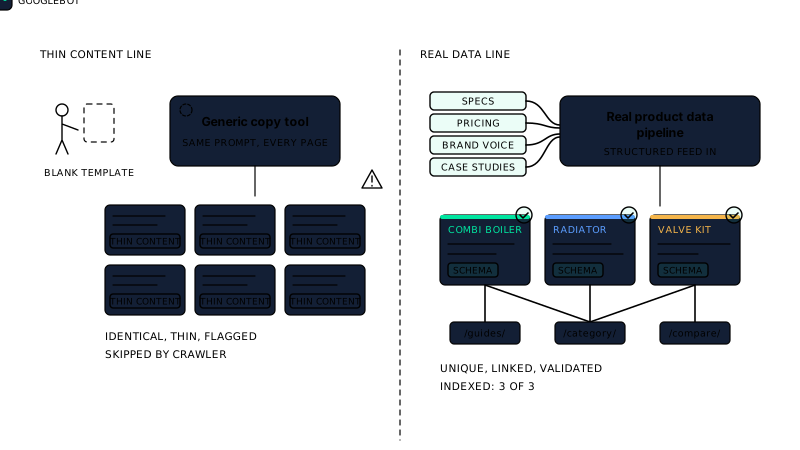
The distinction between real data and filler matters because AI content tools can only be as accurate as the information you give them. Feed a generator a product name and nothing else, and it will produce plausible-sounding copy that may be factually wrong. Feed it a full attribute set and it has something concrete to work with – which is where the process becomes genuinely useful.
How AI turns raw product data into readable, on-brand copy
Once you have a full attribute set, the transformation from data to description is largely a structural problem. A good AI model reads the attributes, identifies which details matter most to a buyer at this stage of their decision, and arranges them into sentences that flow naturally. That sounds simple, but the quality of the output depends entirely on how the prompt is constructed and what constraints you set.
A bare prompt – “write a product description for this kettle” – produces generic output. A structured prompt that passes in the wattage, capacity, colour options, boil time, material, compatible hob types and target use case produces something a customer can actually use. The AI is not inventing anything. It is selecting, ordering and phrasing information you already hold.
This is why product descriptions from product data outperform descriptions written from memory or from a manufacturer’s PDF. The writer, human or AI, is working from a verified source rather than making educated guesses. Errors come from gaps in the data, not from the generation step itself.
There is also a readability dimension. Raw specifications are not copy. A table of numbers does not tell a buyer why those numbers matter. A 2.4-litre capacity means something different to a family of five than to someone making a single espresso. Good AI copy bridges that gap – it contextualises the data for the likely reader rather than simply listing it.
The practical steps look like this:
- Export your WooCommerce product attributes, custom fields and variation data.
- Map each attribute to a buyer question it answers – capacity answers “will this be big enough?”, material answers “is this durable?”
- Pass the mapped data into your AI prompt alongside clear instructions on length, tone and structure.
- Review the output against the source data before publishing.
Feeding your brand profile into the process
Accurate copy is necessary, but it is not sufficient. Two competing stores could describe the same product with identical facts and still sound completely different – because tone, vocabulary and emphasis reflect a brand, not just a product.
This is where a brand profile becomes essential. A brand profile captures the things that should stay consistent across every piece of copy you produce: the words you use and avoid, the level of formality, the customer you are writing for, and the values you want to reinforce. Without it, AI-generated descriptions at volume will drift. Some will sound confident and direct. Others will sound hesitant or overly technical. Readers notice that inconsistency even when they cannot name it.
A well-built brand profile feeds directly into the generation process. Before the AI writes a single sentence, it knows whether your store speaks to professional tradespeople or first-time buyers, whether you prefer plain English or technical precision, and which claims you are authorised to make. That context shapes every output without requiring you to rewrite the prompt for each product.
In practice, this means you can generate descriptions across an entire product category and maintain a consistent voice throughout – even across hundreds of SKUs. The data provides the accuracy. The brand profile provides the character. Neither works as well without the other.
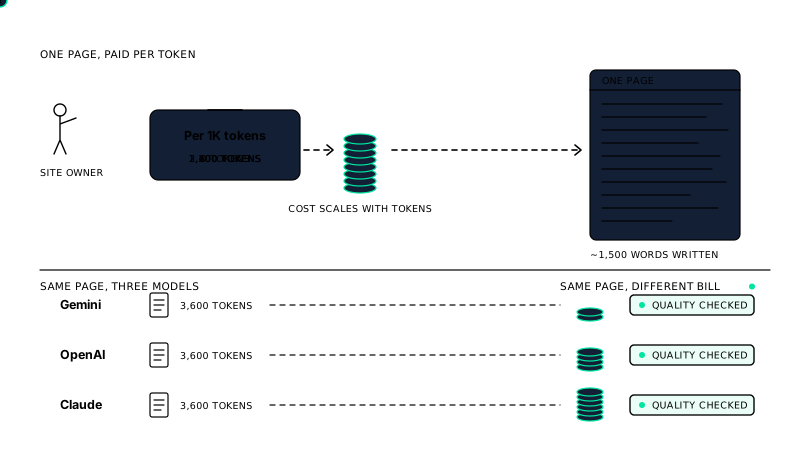
One thing worth checking before you scale up: run a sample batch through a quality review before committing to full production. A 38-check quality gate catches common failure modes – factual gaps, tone drift, readability problems and duplicate phrasing – before they reach your live store. Catching these issues at the sample stage saves significant time compared to auditing a thousand published pages later.
Avoiding scaled content abuse when generating at volume
Scaling product descriptions from real product data is genuinely useful. It is also where things can go wrong if you treat volume as the goal rather than quality.
Google’s guidance on scaled content abuse focuses on one question: does the content exist to help users, or does it exist primarily to manipulate rankings? Generating hundreds of descriptions that are structurally identical, thinly varied and offer no real value to a reader is exactly the pattern that attracts a manual action. The fact that AI produced the copy does not change the risk. What matters is the output, not the method.
The safest way to scale without crossing that line is to make sure each description earns its place. If two product variants share the same attributes in every meaningful way, a single well-written description with a variation selector is more honest than two near-duplicate pages. Where products genuinely differ – different materials, different capacities, different use cases – the copy should reflect those differences clearly and specifically.
A few practical rules help here:
- Do not generate a separate page for a product that has no distinct attributes to describe.
- Vary the structure as well as the content – if every description follows the same sentence order, readers and crawlers notice.
- Prioritise the attributes that actually influence a purchase decision. Filler detail pads word count without adding value.
- Check a sample batch before full production. Catching tone drift or repeated phrasing across ten descriptions is manageable. Catching it across a thousand is not.
Scaling responsibly also means keeping a human in the loop. AI handles the first draft. A person confirms the output reflects the product accurately and reads naturally before it goes live. That review step is not optional at volume – it is what separates useful automation from content spam.
Structured data and why it belongs alongside your product descriptions
A well-written product description does a good job for the reader who reaches your page. Structured data does a different job: it tells search engines exactly what your page contains, in a format they can act on.
For WooCommerce product pages, Product schema is the most directly useful type. It lets you mark up price, availability, SKU, brand, reviews and product condition in a machine-readable format. When Google can read those fields reliably, it can surface rich results – price annotations, availability labels, review stars – directly in the search listing. That additional information can improve click-through rates without any change to your ranking position.
The connection between structured data and your written description matters more than most people realise. If your description says “available in three sizes” but your schema marks up only one product variant, there is a mismatch. Search engines are increasingly good at spotting inconsistencies between on-page copy and structured markup, and inconsistency reduces confidence in both signals. The description and the schema should tell the same story.
This is also where Writrex’s structured data feature fits naturally into a product content workflow. Rather than treating schema as a separate technical task, it generates and attaches markup alongside the written copy, using the same source data. The result is alignment by default rather than something you have to audit manually after the fact.
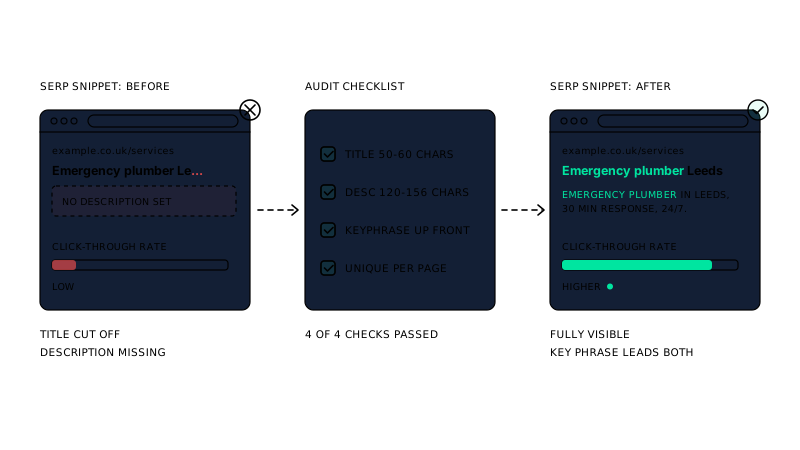
If you are auditing existing product pages, check whether your current descriptions and schema agree on the details that matter most: price range, availability and product name. Discrepancies are common on stores that built their catalogue gradually and updated copy without touching the markup. The meta titles and descriptions audit checklist covers related consistency checks that apply equally well to product page elements.
One final point: structured data is not a ranking factor in the direct sense, but it does influence how your results appear. A listing with rich annotations stands out in a crowded results page. That visibility compounds over time, particularly for product categories where several competitors rank at similar positions.
Internal linking from product pages: the orphan problem
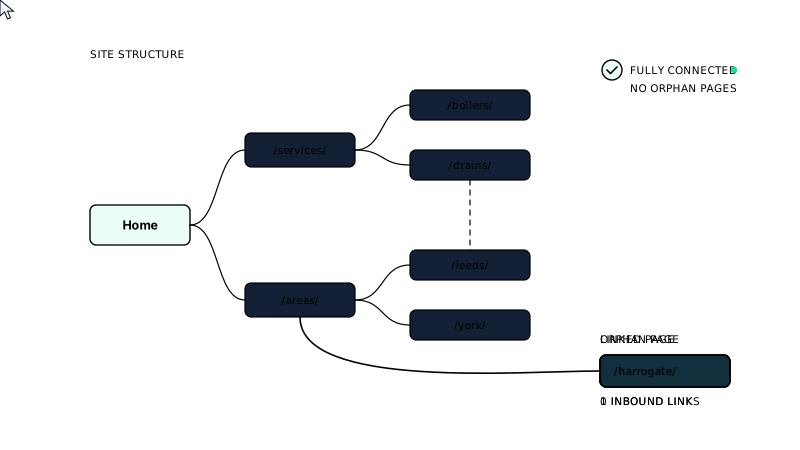
Product pages are some of the most link-poor pages on a typical WooCommerce store. Category pages link down to products, but products rarely link anywhere useful in return. That one-way flow leaves many product pages sitting in isolation, receiving no internal link equity from the rest of the site and passing none back.
This matters because search engines use internal links to understand site structure and to decide how much weight to give individual pages. A product page that no other page links to – an orphan – is harder to index reliably and harder to rank, regardless of how good the copy is.
The fix is not to stuff every product description with links. It is to think about where a product page genuinely belongs in your site’s content structure. A description for a waterproof walking boot could reasonably link to a buying guide for hiking gear, a care and maintenance article, or a size guide page. Those links help the reader and signal to search engines that your product page is part of a coherent, connected site.
The challenge at volume is keeping track of which pages link to which, and spotting the gaps. Finding and fixing orphan pages on a WordPress site is worth reading before you scale up product content generation, because adding hundreds of new product pages without an internal linking plan makes the orphan problem significantly worse.
Writrex includes internal linking with orphan and overlap detection, which flags pages that have no inbound links and identifies where the same topic is covered by multiple pages competing with each other. Both problems are common in large WooCommerce catalogues and both are easier to prevent than to fix retrospectively.
Quality checks you should run before publishing
Generating product descriptions from real product data removes the risk of invented specifications, but it does not remove the need for a quality review. Before any product page goes live, run through these checks:
- Accuracy: Does every claim in the description match the source data? Pay particular attention to dimensions, materials, compatibility and availability.
- Readability: Read the copy aloud. If it sounds mechanical or repetitive across multiple products, the tone of voice settings in your brand profile need adjusting.
- Uniqueness: Run a spot-check on a sample of descriptions to confirm they are genuinely distinct from each other, not just the same template with different nouns swapped in.
- Schema alignment: Confirm that the written copy and the structured markup agree on price, availability and product name, as covered in the previous section.
- Meta title and description: These are separate from the body copy but equally important. Check that the product name and a key differentiator appear in both, and that neither is truncated in search results.
- Internal links: Confirm the page links to at least one relevant piece of supporting content, and that at least one other page on the site links back to it.
At scale, you will not manually review every page in full. A sensible approach is to review every page in a new product category carefully, then spot-check a percentage of subsequent pages once you have confirmed the process is producing consistent output. If a batch fails a spot-check, review the whole batch before publishing.
Quality at volume is a process question, not just a technology question. The tools can generate accurate, on-brand copy reliably. The discipline of checking that they are doing so is still yours to maintain.
Frequently asked questions
Can I generate product descriptions from product data without writing a single word myself?
Yes, if your source data is complete. The AI needs accurate inputs: dimensions, materials, pricing, compatibility notes and any differentiating features. If those exist in your WooCommerce product fields or a spreadsheet, the tool can produce ready-to-publish copy. The more specific your data, the less manual editing you will need afterwards.
Will Google penalise AI-generated product descriptions?
Google’s stated position is that it evaluates content quality, not how it was produced. Copy that is accurate, helpful and genuinely distinct from competing pages is unlikely to attract a penalty. Copy that is thin, repetitive or clearly templated is a risk regardless of whether a human or a machine wrote it. Read what Google actually says about AI-generated content for the full picture.
How do I stop descriptions sounding identical across a large product catalogue?
The main levers are your brand profile settings and the specificity of your input data. If every product in a category shares the same three bullet points and a generic closing sentence, the tone of voice instructions are too vague and the data is too thin. Push more product-specific detail into the input and tighten the tone guidance.
What is the difference between product descriptions from product data and standard AI content generation?
Standard AI generation often works from a brief or a prompt alone, which means the model fills gaps with plausible-sounding but unverified claims. Generating product descriptions from product data means the copy is grounded in verified facts you supply. The model structures and phrases the information rather than inventing it, which is a meaningful difference for accuracy and trust.
Do I need technical knowledge to set this up on WooCommerce?
Not much. Most tools that connect to WooCommerce read existing product fields automatically. The setup work is mainly configuring your tone of voice and reviewing the first batch of output carefully. The Writrex documentation walks through the connection and configuration steps without assuming any developer background.
Writing product descriptions from product data is straightforward in principle. The discipline is in keeping your source data clean, your brand settings specific and your quality process consistent as you scale. Get those three things right and the output takes care of itself.
Writrex writes from your real business facts and checks every page before it publishes. Start with Writrex Lite for free.