Few SEO topics attract more confident, contradictory advice than AI-generated content. One camp says Google can spot AI writing and buries it. The other says anything goes as long as you publish enough of it. Both are wrong, and following either one can cost you rankings.
The short answer: Google does not penalise content for being written by AI. It penalises content created at scale to manipulate rankings rather than help people, however that content was made. This guide goes through what Google’s own documentation says, what actually gets sites demoted, and how to use AI for content without taking on that risk.
Where Google’s position comes from
Google’s stance on AI-generated content isn’t hidden. It’s spread across a handful of official documents, and it has stayed consistent since Google first addressed AI content directly in early 2023.
The sources worth knowing:
- Google’s guidance on using generative AI content. A short page in Google Search Central, last updated in December 2025, that sets out how AI content fits Google’s rules.
- Google’s spam policies, in particular the scaled content abuse policy introduced with the March 2024 core update.
- Google’s guide to creating helpful, reliable, people-first content, which describes what its ranking systems try to reward.
- The Search Quality Rater Guidelines, which Google’s human raters use to evaluate search results.
- Google’s 2026 guide to optimising for generative AI search, which covers AI Overviews and AI Mode.
Read together, they say the same thing in different ways: the method doesn’t matter, the result does.
What Google says it rewards
Google’s position rests on a principle older than AI writing tools. Its systems aim to reward original, helpful content that shows experience, expertise, authoritativeness and trustworthiness (E-E-A-T), whether a person wrote it, a person wrote it with AI help, or AI drafted it and a person edited it.
Google’s generative AI guidance recognises that AI is genuinely useful for researching a topic and giving structure to original content. What it warns against is using AI to churn out large numbers of pages that add nothing for the reader.
That distinction matters. “AI-generated content” isn’t a category Google ranks lower. “Content that doesn’t help anyone” is, and AI simply makes it cheaper to produce a lot of that.
What scaled content abuse actually covers
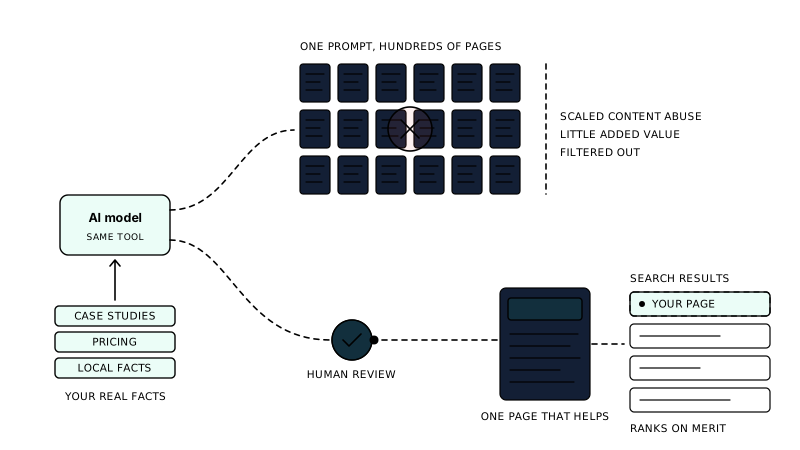
The scaled content abuse policy is the rule that affects AI-generated content most directly. It targets sites that publish many pages mainly to rank rather than to help, usually large volumes of unoriginal content with little value. The policy states clearly that it applies no matter how the content is created.
Google’s examples include:
- Using generative AI tools to produce many pages without adding value for users
- Scraping feeds, search results or other sites to produce pages, including content disguised through automatic rewording, translation or other obfuscation
- Stitching together content from different pages without adding anything new
- Spreading content across multiple sites to hide how much of it was mass-produced
- Publishing pages that make little sense to a reader but contain search keywords
Look closely at the second example. Running AI text through a “humaniser” or synonym tool to dodge detection doesn’t make it safe. Google lists automated rewording as one of the techniques the policy covers. The problem was never how the text reads. It’s whether the page adds anything.
Google treats this as spam, which means consequences can go beyond a ranking drop: affected pages or whole sites can rank lower or disappear from results, and serious cases can receive a manual action in Search Console.
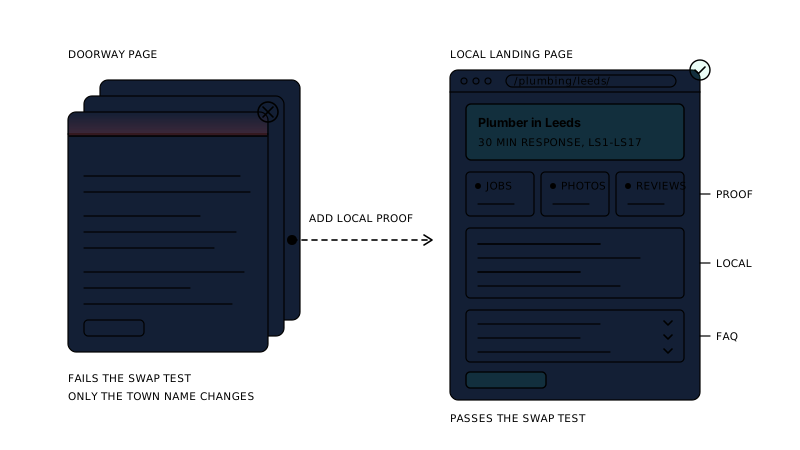
If you run location pages, this policy sits right beside the doorway abuse policy. Our guide to building local landing pages without doorway-page risk covers that overlap in detail.
What the quality rater guidelines add
Google’s generative AI guidance points site owners to two sections of the Search Quality Rater Guidelines: one on scaled content abuse and one on content created with little effort, little originality and little added value. Raters are told to give such pages the lowest quality ratings.
Two things are worth understanding here. First, raters don’t rank your site. Their ratings help Google evaluate whether its ranking systems are working, and they don’t directly move any individual page. Second, the guidelines show what Google’s systems are designed to recognise. If raters are trained to spot low-effort, unoriginal pages, the ranking systems they evaluate are being tuned in the same direction.
The practical takeaway: effort and originality are what count. A page that looks like the output of a single prompt, with generic statements, no specific examples and nothing a reader couldn’t find anywhere else, is the pattern raters are taught to mark down.
Five myths about Google and AI content
“Google can detect AI writing and penalises it”
Google has never said it penalises content for being AI-written, and its documentation consistently says the opposite. It assesses quality and purpose. Well-edited, accurate, useful AI-assisted content is treated like any other content.
“You have to label AI content”
For ordinary web pages, Google suggests giving readers context about how content was made where they would reasonably expect it, for example explaining how automation was used. That is a recommendation, not a ranking requirement. Google has also said that simply listing AI as the author isn’t a good way to be transparent. Bylines should name the real people or organisation responsible for the content.
Ecommerce is the exception. If you use Google Merchant Center, AI-generated product images must carry the IPTC TrainedAlgorithmicMedia metadata, and AI-generated product titles and descriptions must be supplied separately and labelled as AI-generated. WooCommerce store owners feeding products to Google Shopping should check this carefully.
“AI content can’t rank”
It can and does. AI-assisted pages built from real information, reviewed for accuracy and written to answer a real question compete on the same terms as anything else. The pages that fail are the ones with nothing behind them.
“More pages means more traffic”
This is the thinking that causes scaled content abuse in the first place. Publishing hundreds of thin pages rarely adds traffic, and it can drag down how Google views the rest of your site. Fewer, better pages almost always win.
“AI search needs special formatting”
Google’s 2026 guide to its generative AI features is direct about this. It says content doesn’t need to be broken into small chunks for AI systems, and special schema or Markdown versions of pages aren’t required for inclusion. The same fundamentals apply: useful, original content on a technically sound site. Google also warns against creating separate pages for every variation of a question, which is scaled content abuse under a new name.
Accuracy matters more when AI is involved
Google’s generative AI guidance asks for particular care with accuracy, quality and relevance when content is generated automatically. That covers more than the body text. It includes page titles, meta descriptions, structured data and image alt text, because all of these can appear directly in search results.
This is where AI content most often goes wrong in practice:
- Statistics that sound plausible but have no source
- Claims about your own business, prices or service areas that simply aren’t true
- Structured data describing things that aren’t on the page
- Meta descriptions that promise content the page doesn’t deliver
- Alt text that describes an image generically instead of what it actually shows
Every one of these is a trust problem as well as an SEO one. A person who knows the subject needs to check AI output before it goes live, especially anything a customer might act on.
How to use AI for content without the risk
The safe approach follows directly from what Google says it rewards and what it treats as spam.
- Start from real information. Give the AI your own facts: customer questions, case studies, pricing, local knowledge, product data. Output built on generic prompts will be generic.
- Add what only you know. First-hand experience, real examples, your own data and a clear opinion are what separate your page from the thousands of others on the same topic.
- Check every fact. Treat AI drafts like work from a fast junior writer who is sometimes confidently wrong.
- Publish at a pace you can review. If you can’t properly check a page before it goes live, you’re publishing too fast.
- Name the people responsible. Clear authorship and a real editorial process build trust with readers and with Google.
- Measure and prune. Watch Search Console. Improve pages that attract impressions but no clicks, and merge or remove pages that never earn attention. Search Console now also has a Generative AI performance report showing how people find your content through Google’s AI features.
Warning signs your AI content is at risk
Review your site if you notice any of these:
- Many pages that are near-identical apart from a keyword or place name
- A growing number of pages marked “Crawled – currently not indexed” in Search Console
- Pages that could sit on any competitor’s site without changing a word
- Content that no one in your business has read before it was published
- Factual errors that customers or colleagues have pointed out
- Traffic that rose quickly after a publishing spree, then fell away
None of these alone means a penalty is coming. Together, they describe the pattern Google’s policies are written to catch.
Where Writrex fits
We built Writrex because AI content tools made it too easy to publish the kind of pages Google’s policies target. Brand profiles hold your real case studies, pricing and tone of voice, so every page starts from your facts. A 38-check quality gate holds back pages that come out thin or generic before they publish, and overlap warnings flag new pages that would compete with ones you already have. The aim isn’t more pages. It’s pages worth ranking.
Frequently asked questions
Does Google penalise AI-generated content?
No. Google doesn’t penalise content for being AI-generated. It demotes content that is unhelpful or created at scale mainly to manipulate rankings, whether a person, a template or AI produced it.
Can Google detect AI-generated content?
Google hasn’t said it ranks content based on whether AI wrote it. Its systems focus on quality and usefulness, so trying to disguise AI text doesn’t help. Google’s spam policy lists automated rewording and similar obfuscation as part of the problem, not a fix.
Do I need to disclose AI-generated content?
For most web pages, it isn’t a ranking requirement, but Google suggests explaining how content was made where readers would expect it. Google Merchant Center does require AI-generated product images and product data to be labelled.
What is scaled content abuse?
It’s Google’s spam policy against publishing many pages mainly to rank rather than to help people. It covers mass-produced AI content, scraped or reworded content, and pages stitched together from other sites without adding value.
How much AI content is too much?
There’s no percentage limit. What matters is whether each page adds real value. One strong, reviewed AI-assisted article is fine. A thousand unreviewed pages on near-identical topics is not.
Google’s message on AI-generated content has been consistent for years: it cares about what a page does for the reader, not how it was written. Use AI to work faster, but put your own knowledge, facts and judgement into every page.
Writrex writes from your real business facts and checks every page before it publishes. Start with Writrex Lite for free.