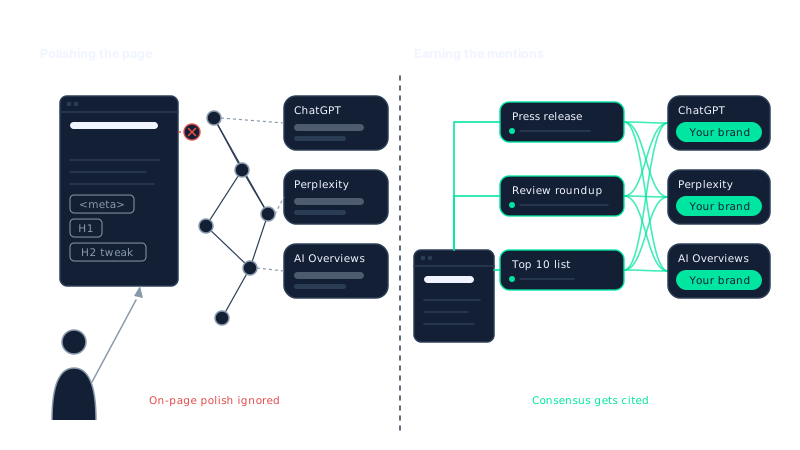
Digital PR for AI visibility is now more important than any on-page tweak you can make to your own site. If your goal is to appear in ChatGPT answers, Perplexity citations, or Google AI Overviews, the evidence from 2026 is clear: what other websites say about you matters far more than what you say about yourself.
Most site owners are still pouring time into title tags, heading structures, and schema markup on their own pages. Those things still matter, but they are not what gets you cited by a large language model. The signal LLMs trust most is third-party editorial consensus, and you cannot manufacture that from inside your own WordPress dashboard.
This piece explains what the 2026 data shows, why AI systems are wired to favour external sources, and what a practical earned media strategy looks like for WordPress site owners, SaaS founders, and local SEO marketers who want to show up when AI answers questions in their niche.
The on-page optimisation trap most site owners fall into
The instinct to optimise your own content is understandable. You control it, you can change it today, and the feedback loop from tools like Google Search Console feels immediate. So when AI search visibility becomes a priority, most people do what they already know: they rewrite meta descriptions, add FAQ schema, tighten headings, and publish more blog posts.
None of that is wasted work. A well-structured page with structured data and clean internal linking still forms the foundation of any serious SEO effort. But when it comes to earning citations from AI systems, on-page changes on brand-owned pages hit a ceiling very quickly. The reason is not technical. It is a trust problem.
LLMs are trained to synthesise information from across the web, and they apply an implicit weighting to sources. A page on your own domain telling readers that your product is excellent carries roughly the same credibility with an AI system as a salesperson telling you their own product is excellent. The model has seen enough of the web to know the difference between a brand speaking for itself and an independent source reaching a conclusion.
The trap is spending months refining content that AI systems will always treat as a primary source with an obvious conflict of interest, while ignoring the third-party coverage that would actually move the needle. Understanding how generative engine optimisation works for WordPress sites makes this distinction much clearer.
What the 2026 citation data actually shows
The numbers from 2026 research are striking enough to change how you allocate your content budget.
Muck Rack’s 2026 research found that 84% of AI citations come from earned media – third-party editorial coverage – rather than brand-owned pages or paid placements. That single figure reframes the entire conversation about AI search strategy.
An AirOps analysis of 21,311 brand mentions across ChatGPT (GPT-5), Claude Sonnet 4.5, and Perplexity Sonar reinforced this finding with more granular detail. Of all brand mentions recorded, 85% came from external sources. Only 13.2% originated from brand-owned websites. In other words, even when an AI system mentions your brand by name, the source it is drawing on is almost certainly not your own site.
The practical implication is direct: if you are not generating third-party coverage, you are effectively invisible to AI citation systems regardless of how well-optimised your own pages are. Publishing more on your own blog will not close that gap. Building a presence in the external sources that AI models trust is the only way to do it.
These figures also suggest that the common assumption – that ranking well in Google automatically translates to AI visibility – is not reliable. The data points to a separate and distinct pathway to AI citation, one that runs through editorial coverage rather than traditional search rankings.
Why LLMs trust third-party sources over brand-owned pages
The trust gap between brand-owned content and third-party coverage is not a quirk of how AI systems are configured. It reflects something more fundamental about how large language models are trained. During training, an LLM ingests enormous volumes of web content and, in doing so, absorbs the implicit signals humans use to judge credibility. One of those signals is whether the source of a claim has a financial or reputational stake in the claim being believed.
Your product page saying your software is the best option for small agencies is structurally identical, from the model’s perspective, to a press release or a paid advertorial. The domain itself signals intent. A technology review site, an independent comparison blog, or an industry newsletter reaching the same conclusion carries a different signal entirely. The author has no obvious incentive to favour your product, which makes the endorsement more meaningful to both human readers and the models trained on their behaviour.
There is also a volume and consensus dimension. When multiple independent sources reach similar conclusions about a product or service, AI systems treat that convergence as a stronger signal than any single authoritative page, including your own. This is why a cluster of mid-authority review sites all listing you in the same category can outperform a single, technically perfect page on your own domain. The model is looking for agreement across sources, not perfection within one.
This has a direct consequence for how you should think about content quality. Strong on-page content, accurate structured data, and a clear brand profile that keeps your tone and facts consistent across every page are still necessary. They give external authors accurate information to reference and quote. But they are inputs to an earned media strategy, not a substitute for one.
Where AI citations really come from: reviews, comparisons and listicles
If the broad finding is that third-party sources dominate AI citations, the more granular finding tells you exactly which types of third-party content matter most. Nearly 90% of third-party AI citations come from reviews, comparisons, and listicles. That is a remarkably concentrated distribution, and it points directly at where your digital PR energy should go.
The format makes sense when you think about how AI systems answer questions. A user asking “what is the best project management tool for freelancers” is not looking for a brand’s own answer. The AI is looking for sources that have already done the comparative work: articles that evaluated multiple options, applied consistent criteria, and reached a ranked conclusion. Reviews, comparisons, and listicles are exactly that kind of content. They are pre-synthesised judgements from sources with no single brand allegiance.
The positioning detail inside those formats is equally important. Of the brands that appear in AI citations drawn from these sources, 80% appear within the top three positions of the list or comparison. Being mentioned fifth or sixth in a “10 best” roundup offers far less citation value than being named in the opening recommendations. This means your outreach goal is not simply to appear in third-party content. It is to appear prominently, with a strong rationale for the ranking.
Practically, this shapes the kind of pitches worth making. A generic product mention buried in a long listicle is close to worthless for AI citation purposes. A detailed review that explains why your product suits a specific use case, or a comparison article where you are positioned in the top two or three, is the asset you are actually trying to earn. Understanding the full picture of GEO, AEO and traditional SEO helps clarify why the format and position of third-party coverage matter as much as the coverage itself.
This also means that the quality of your outreach briefing materials matters enormously. If a journalist or blogger is writing a comparison and you give them vague, generic information, you will end up with a vague, generic mention. Specific data points, clear use cases, and honest comparisons with competitors give writers the substance they need to place you at the top of a list rather than as an afterthought.
AI visibility versus traditional Google rankings
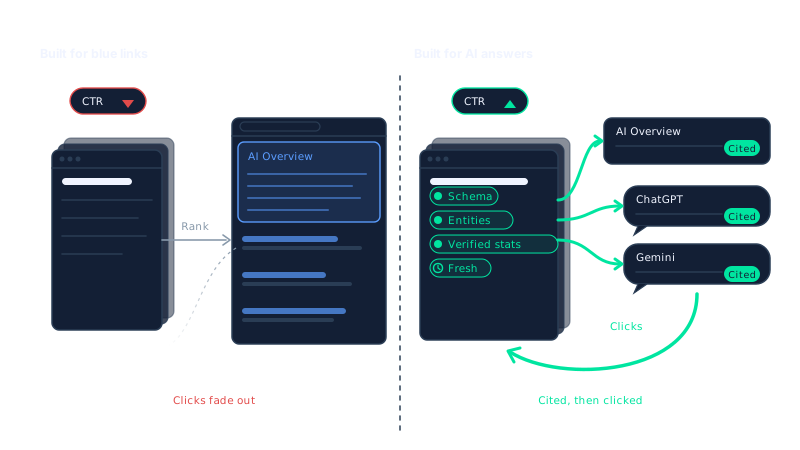
One assumption worth discarding early is that ranking well in Google automatically translates into AI citations. The data says otherwise, and the gap is wider than most people expect.
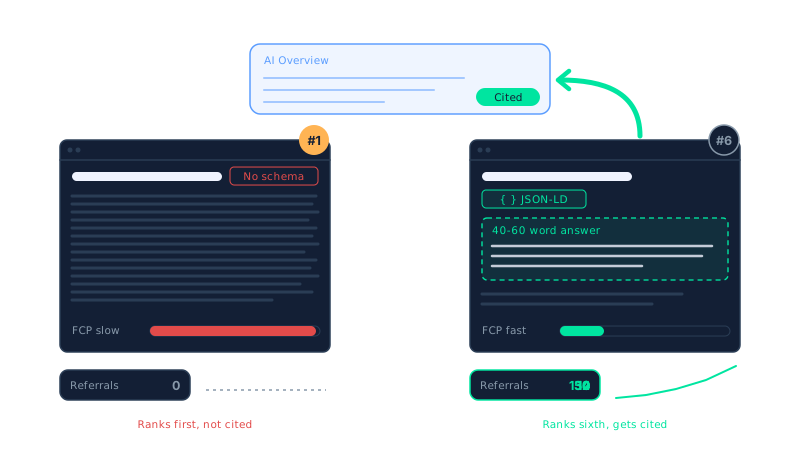
Only 17% to 38% of AI-cited pages also appear in the traditional organic top 10. That means the majority of content that ChatGPT, Perplexity, and Google AI Overviews pull from would not even show up on the first page of a conventional search. The two systems are operating on different signals.
Google’s organic rankings still lean heavily on technical factors: page speed, Core Web Vitals, structured data, backlink authority, and keyword matching. AI citation, by contrast, appears to weight something closer to off-site consensus. When multiple independent sources, across review sites, trade publications, and comparison blogs, consistently reference the same brand in a positive and specific context, that pattern becomes a trust signal for large language models.
This is not an argument against traditional SEO. A well-optimised site is still the foundation. But it is an argument against treating on-page work as sufficient for digital PR for AI visibility. A page can be technically perfect and still be invisible to AI systems if no credible third-party sources are talking about the brand behind it.
The practical implication is that you need to track two separate metrics. Organic ranking tells you how visible you are to people who search. AI citation frequency tells you how visible you are to AI systems that synthesise answers. Right now, most site owners are measuring only the first one.
Why AI-referred traffic converts so much better
There is a straightforward reason to care about all of this beyond visibility. The traffic quality is different.
According to the Opollo 2026 AI Search Benchmark, AI-referred visitors converted at an average rate of 14.2%, compared to 2.8% for traditional Google organic traffic. That is not a marginal difference. It changes the economics of content investment considerably.
The explanation is intent. When someone asks an AI assistant a specific question and receives a recommendation, they arrive at your site already partway through a decision. The AI has done the filtering. The visitor is not browsing. They are evaluating a specific option that has already been vouched for by a source they trusted enough to ask.
Compare that with a typical organic search visit, where a user may be at the very start of their research, comparing dozens of options, and nowhere near a purchase decision. The AI-referred visitor has had much of that early friction removed before they arrive.
This also reframes how you should think about content investment. A piece of third-party coverage that drives 200 AI-referred visitors may be worth more in revenue terms than a blog post that attracts 2,000 organic visitors with diffuse intent. Understanding what AI content really costs per page becomes more meaningful when you can weigh it against the conversion rate of the traffic it is designed to attract.
The higher conversion rate also makes a strong case for investing in the kind of detailed, specific briefing materials that earn prominent third-party coverage. If the end result is traffic that converts at five times the rate of organic search, the effort required to land a strong review or comparison mention has a very different return on investment than it did two years ago.
What this means practically is that AI search citations are not just a vanity metric for brand awareness. They are a commercial channel, and one that rewards the brands willing to build external credibility rather than simply publish more content on their own domains. For a clearer picture of how this fits alongside your existing SEO work, fixing WordPress SEO issues with AI covers how to keep your on-site foundations solid while freeing up effort for off-site authority building.
How outbound citations inside your content build trust with LLMs
Most site owners think of citations as something that happens to them, not something they can build into their own content. But there is a direct on-page action that improves your chances of being cited externally: linking out to authoritative third-party sources from within your own articles.
Research from Princeton and IIT Delhi found that adding five to eight authoritative outbound citations inside an article produced up to a 115% visibility increase for mid-ranked sites in AI search results. The mechanism makes sense. LLMs assess whether a piece of content participates in a broader web of credible sources. A page that cites peer-reviewed research, established publications, or respected industry data signals that it belongs to the same information ecosystem those sources inhabit.
This is different from the old link-building mindset, where outbound links were sometimes treated with suspicion. For AI visibility, generosity with attribution is an asset. Cite your sources explicitly, name the organisations behind the data you reference, and link to the original material rather than a summary. That specificity is exactly what LLMs are trained to reward.
Practically, this means every substantive claim in your content should have a named source. Not a vague reference to “industry research,” but a specific study, report, or publication. This also makes your content more useful to human readers, which is not a coincidence. AI systems have been trained on human judgements of quality, and human readers trust content that shows its working.
A practical digital PR and outbound-citation strategy for 2026
Earning AI citations is not a single tactic. It is a repeatable process built around three activities: getting covered, getting ranked in lists, and making your content easy to cite.
Build a pitchable asset first
Journalists, reviewers, and listicle authors need something concrete to write about. That means producing content or data that is genuinely worth referencing: original survey results, a proprietary methodology, a detailed comparison your competitors have not published, or a specific case study with real numbers. Generic blog posts do not earn coverage. Specific, citable assets do.
Before you pitch anything externally, make sure your own content is structured so that AI systems can read and attribute it cleanly. Proper heading hierarchy, clear authorship, and accurate structured data all contribute to how reliably your content gets attributed when it is cited. The 38-check quality gate in Writrex covers several of these structural requirements automatically, which matters when you are producing content at scale.
Target reviews, comparisons and listicles deliberately
Given that nearly 90% of third-party AI citations come from reviews, comparisons, and listicles, and that 80% of cited brands appear in the top three positions of those lists, your outreach priority should be clear. Identify the top-ranking comparison and review pages in your category. Find out who maintains them. Reach out with specific, factual information about why your product or service belongs in the list, and why it belongs near the top.
This is not about gaming a system. It is about making the case with evidence. Provide pricing, feature comparisons, customer outcomes, and anything else that makes a reviewer’s job easier. The sites that earn AI citations are the ones that give editors the raw material to write confidently about them.
Create a consistent external footprint
AI systems build consensus from multiple sources. One strong review helps. Ten consistent mentions across credible, independent publications help considerably more. Spread your digital PR effort across different publication types: trade press, independent review sites, community forums, and vertical-specific directories. Consistency of information across those sources, especially around your name, category, and key differentiators, reinforces the signal that your brand is a legitimate, established option.
For the on-page side of this, make sure your internal content structure supports the external authority you are building. Internal linking with orphan and overlap detection helps ensure that your most citable pages are properly connected within your site and not buried where neither readers nor crawlers can find them easily.
Digital PR for AI visibility is not a replacement for good content. It is the distribution layer that determines whether that content gets cited when AI systems construct their answers. Without it, even well-written, well-structured pages remain invisible to the systems that are increasingly shaping where search traffic goes.
Frequently asked questions
Does digital PR for AI visibility require a big budget or a PR agency?
No. The most effective tactics are founder-led outreach, contributing expert commentary to journalists, and supplying factual product information to review site editors. A clear data sheet, honest pricing, and a specific angle are more useful than a retainer. Start with five targeted publications in your category before spending anything significant.
How long does it take for third-party mentions to influence AI citations?
There is no fixed timeline, because each AI system indexes and weights sources differently. In practice, coverage on established editorial sites tends to appear in citation pools within weeks of publication. Building a consistent footprint across multiple credible sources accelerates the process more reliably than a single high-profile placement.
Do brand-owned pages have any role at all in AI citation strategies?
Yes, but a supporting one. Brand-owned pages provide the citable facts, pricing, and structured information that third-party editors draw from. The AirOps analysis found only 13.2% of brand mentions originated from brand-owned sites, so your pages set the foundation. External sources do the citing. Both matter, but in different ways.
Which types of sites should I prioritise for outreach?
Focus on independent review sites, category comparison pages, and trade publications that already rank for terms your buyers search. Nearly 90% of third-party AI citations come from reviews, comparisons, and listicles, and appearing in the top three positions on those lists carries the most weight. Vertical-specific directories and active community forums are secondary but still useful.
Should I add outbound citations to every page I publish?
Not mechanically, but yes where it is editorially honest. Research from Princeton and IIT Delhi found that five to eight authoritative outbound citations per article produced up to a 115% visibility increase for mid-ranked sites. Link to primary sources, original studies, and authoritative references that genuinely support your claims. For more on producing content that meets this standard at scale, see how to scale AI content without triggering Google’s spam policies.
On-page optimisation remains the foundation, but it is no longer the ceiling. The sites earning AI citations in 2026 are the ones that have built genuine external authority through editorial coverage, reviews, and consistent third-party mentions. Getting your content structure right is the first step. Getting other credible sources to write about you is what turns that structure into citations. If you want a clearer picture of how AI systems decide what to cite, what Google actually says about AI-generated content is a useful reference point.
Writrex writes from your real business facts and checks every page before it publishes. Start with Writrex Lite for free.